
The Theory of Forms: The Product North Star

Inside every great tech company, there is a constant, healthy tension between the Product team and the Engineering team.
The Head of Product pitches a revolutionary, seamless, perfectly intuitive new feature. They have beautiful Figma mockups. It is flawless.
Then, the Engineering team attempts to build it. They hit API rate limits. The legacy database schema doesn't support the new data model. The UI stutters on older Android devices. When the feature finally ships, it is a slightly clunky, compromised version of the original pitch. The Product team is disappointed, and the Engineering team feels unappreciated.
This friction occurs because the Product team is living in the abstract realm of ideas, while the Engineering team is bound by the messy laws of physics and code.
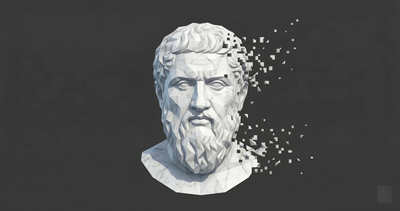
To resolve this tension and turn it into a competitive advantage, the Chief Wise Officer uses a 2,400-year-old framework: Plato’s Theory of Forms. It is the ultimate philosophical justification for the modern Agile framework.
The Perfect Circle vs. The Drawn Circle
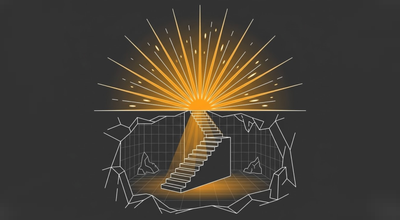
Plato believed that the physical world we live in is not the ultimate reality. He argued that there are two distinct realms:
- The Physical World: The messy, changing, imperfect reality we can touch and see.
- The World of Forms (Eidos): An abstract, higher dimension where the absolute, perfect versions of all things exist.
If you draw a circle on a whiteboard, it is never perfectly round. The marker skips, your hand shakes, and the pixels on a screen are ultimately square. A perfect physical circle does not exist. However, the concept of a perfect circle—its "Form"—exists purely in our minds. Every circle ever drawn is just a flawed physical copy striving to be the perfect Form.
The Vaporware Trap
In software development, your "North Star" product vision is the Platonic Form. It is the perfect, bug-free, infinitely scalable idea in the founder’s head.
When a company uses rigid, old-school Waterfall development, they are attempting to build the perfect Form all at once. They refuse to release anything until the physical code exactly matches the flawless abstract vision. Because this is physically impossible, the project suffers endless delays, bloated budgets, and ultimately becomes "vaporware"—a perfect idea that never actually ships.
The Chief Wise Officer understands that you cannot birth a perfect Form into the physical world. You must build a bridge.
The CWO Strategy: Agile as a Philosophical Bridge
Modern Agile development—when executed correctly—is the most brilliant operational application of Plato’s theory ever invented. It accepts the imperfection of reality while relentlessly pursuing the perfect ideal.
1. Define the North Star (The Form) You cannot run a fast-paced Agile sprint without a destination. The CWO ensures that the executive team has defined the pure, uncompromised "Form" of the product. This North Star vision must be communicated to every single engineer and designer. Even if you know you will never reach absolute perfection, the Form acts as the unmoving gravitational center for all roadmap decisions.
2. Celebrate the Shadow (The MVP) When you launch Version 1.0 (the MVP), it will be flawed. It will be missing features, and the UI will have rough edges. It is merely a shadow of the North Star. The CWO must protect the engineering team from visionary disappointment. Celebrate the MVP. It may be a flawed copy, but it has one massive advantage over the perfect Form: it actually exists in the real world, where users can interact with it and pay for it.
3. Iterate Toward Perfection This is where Agile shines. Once the flawed physical copy is in the market, every subsequent two-week sprint is a deliberate, calculated step to make the physical product resemble the abstract Form more closely. You smooth out the latency. You refactor the database. You refine the UI. You accept that reality is messy, but you use continuous deployment to aggressively close the gap between what is and what should be.
Conclusion: Reconciling the Dream and the Reality
Great companies require both the dreamers and the builders.
If you only have pragmatic engineers, you will build a highly functional, boring product that lacks vision. If you only have visionary product managers, you will draw beautiful, perfect concepts that never ship.
Use Plato’s Theory of Forms to align them. Let the Product team define the perfect, unyielding North Star. Let the Engineering team ship the messy, physical reality. And use your Agile methodology to steadily pull the reality up toward the dream, one sprint at a time.
No spam, no sharing to third party. Only you and me.

Member discussion