
The Black Swan: Preparing for the Unpredictable
Every December, corporate strategy teams lock themselves in conference rooms to write their "Annual Forecasts." They build massive financial models, analyze market trends, and confidently predict the company’s growth trajectory for the next 12 to 36 months.
They present these spreadsheets to the board as if they are physics equations.
But history is not driven by the predictable trends sitting in the middle of a bell curve. History is driven by the extreme, unpredictable outliers. A global pandemic. A sudden geopolitical war. A revolutionary technology that drops out of nowhere. A localized banking collapse.
When these events hit, the 36-month strategic forecast goes out the window in exactly three seconds.
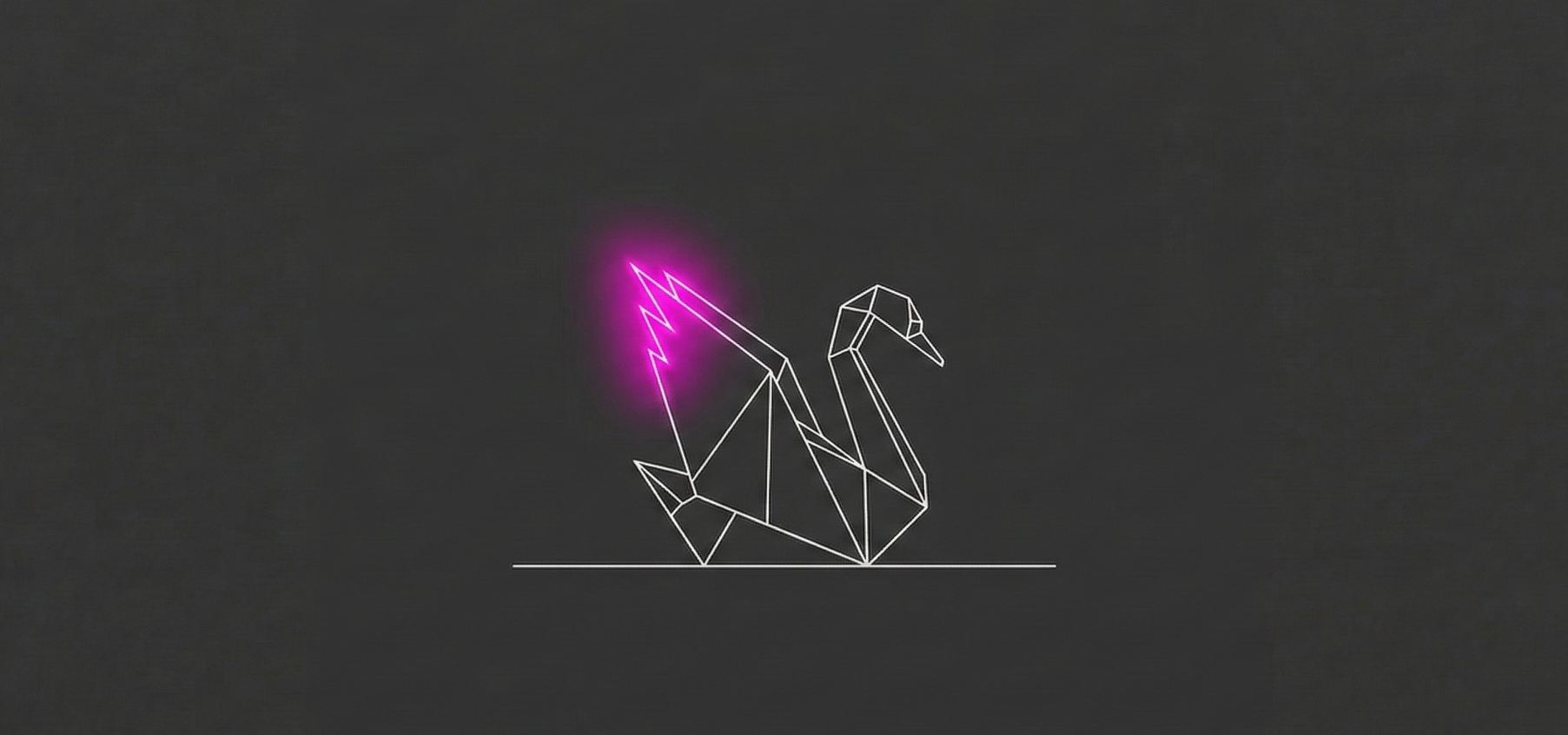
Drawing heavily on Karl Popper’s philosophy of knowledge, author and former options trader Nassim Nicholas Taleb popularized a name for these outlier events: The Black Swan.
For the Chief Wise Officer, recognizing the existence of Black Swans fundamentally changes how you view risk. It forces you to stop wasting millions of dollars trying to predict the future, and start spending your capital preparing for the unknown.
The Anatomy of a Black Swan
A Black Swan is an event that possesses three distinct characteristics:
- Rarity: It is an outlier. It lies completely outside the realm of regular expectations because nothing in the past can convincingly point to its possibility.
- Extreme Impact: When it hits, it carries a massive, disproportionate impact on the business, the market, or the world.
- Retrospective Predictability: Human beings hate uncertainty. So, after the Black Swan happens, we immediately invent explanations for its occurrence, making it seem explainable and predictable in hindsight. (e.g., "Of course the housing market was going to crash in 2008, the signs were all there!")
The Forecasting Fallacy
Why do our highly paid strategic models fail to see Black Swans? Because corporate risk management relies on the wrong mathematical models.
Most business forecasting uses the standard "bell curve" (normal distribution). The bell curve is great for measuring physical things—like the heights of employees. If you add the tallest man in the world to a stadium of 10,000 people, the average height of the stadium barely changes. The extremes do not impact the total. Taleb calls this environment "Mediocristan."
But modern business does not operate in Mediocristan. It operates in "Extremistan." In Extremistan, a single outlier can dominate the entire system. If you put 10,000 random people in a stadium and then add Elon Musk, the average net worth of the stadium suddenly jumps to over $20 million per person. One single data point changes the entire reality.
When your risk analysts use Mediocristan math (bell curves) to predict an Extremistan world (global markets, tech disruptions), they are driving a car blindfolded. They are ignoring the only events that actually matter.
The CWO Strategy: Robustness over Prediction
If you accept that the most impactful events are inherently unpredictable, the entire discipline of "Strategic Forecasting" becomes a dangerous illusion.
The Chief Wise Officer shifts the organization’s focus. You cannot predict the storm, but you can build a stronger ship.
1. Build Redundancy (Inefficiency is a Feature) Modern supply chains and corporate structures have been optimized for maximum efficiency ("Just-in-Time" manufacturing). But hyper-efficiency removes all slack from the system. When a Black Swan hits (like a canal blockage or a pandemic), hyper-efficient systems instantly shatter. Robust companies build intentional redundancies. They hold extra cash. They use multiple suppliers, even if it costs slightly more. They view "slack" not as a waste of money, but as an insurance premium for survival.
2. Adopt the Barbell Strategy How do you invest your time and capital in an unpredictable world? Use the Barbell Strategy.
- On one end of the barbell, be hyper-conservative. Put 85% to 90% of your resources into extremely safe, boring, highly predictable bets that guarantee the company survives no matter what happens.
- On the other end of the barbell, be hyper-aggressive. Put 10% to 15% of your resources into massive, high-risk, "crazy" bets.
You expose yourself to positive Black Swans (a moonshot product that explodes in popularity) while mathematically capping your downside risk so a negative Black Swan cannot wipe you out.
3. Fire the "Experts" Stop paying high-priced macroeconomic consultants to tell you what the market will do next year. They do not know. Their models are inherently flawed because they cannot model the un-modelable. Base your strategy on the current reality of your balance sheet and your customers, not on a consultant's hallucination of the future.
Conclusion: Embracing the Unknown
The illusion of predictability is comforting. It allows executives to sleep at night.
But true leadership requires the courage to look at a complex, chaotic world and say, "I do not know what is going to happen tomorrow." Stop trying to guess the shape of the next crisis. Start building an organization that is so robust, so well-capitalized, and so culturally resilient that it doesn't matter what color the swan is when it finally lands.
No spam, no sharing to third party. Only you and me.




Member discussion