
Lexicon: The Barber Paradox
The Origin
Formulated by Bertrand Russell in 1901. It is a simplified, layperson's version of the mathematical flaw he discovered in Set Theory (known formally as Russell's Paradox).
The Definition
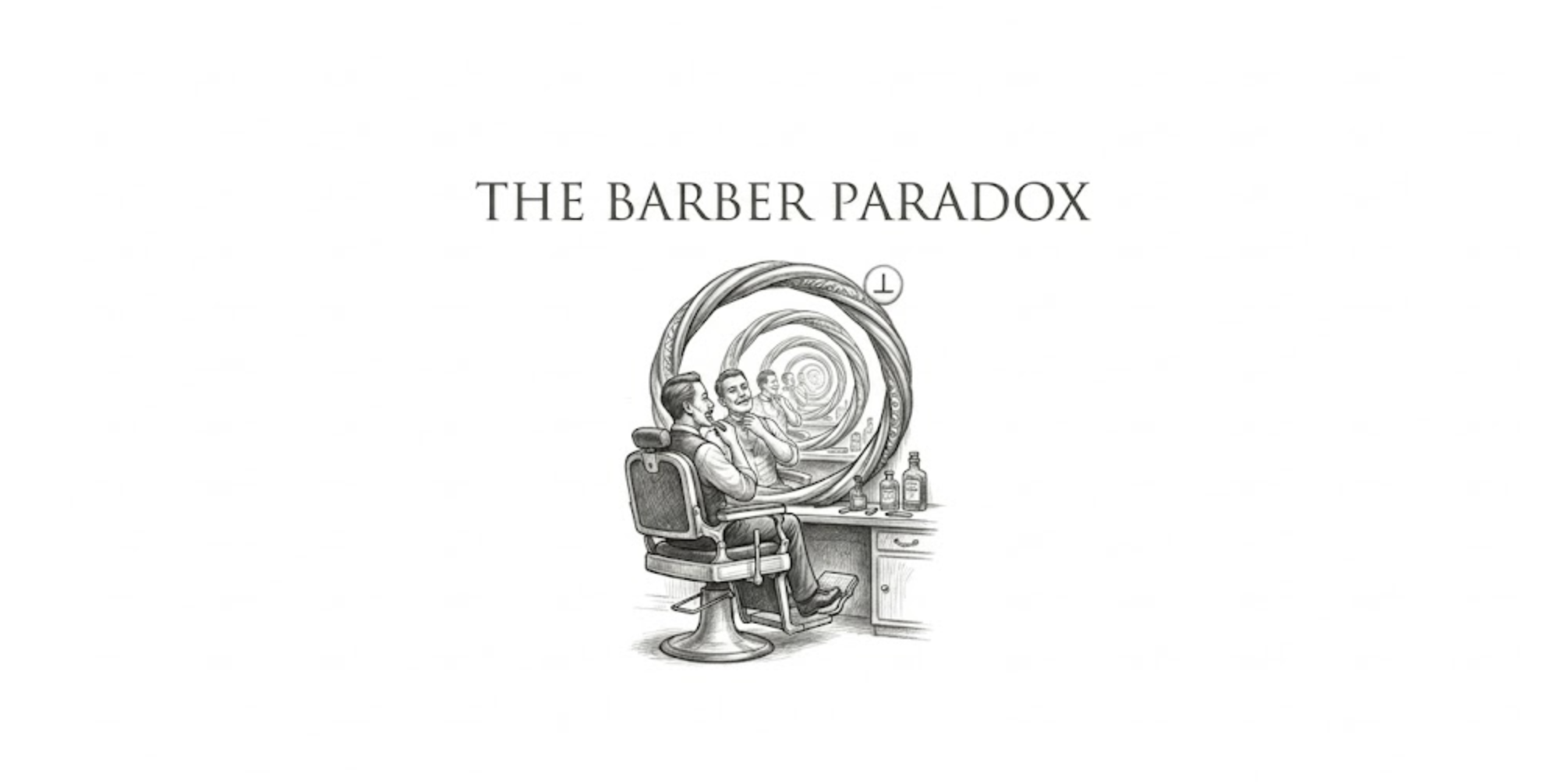
Imagine a small town with only one rule regarding facial hair:The barber shaves all those, and only those, who do not shave themselves.
It seems like a perfectly logical, mutually exclusive categorization of the town's men: those who shave themselves, and those who go to the barber. But then you ask the fatal question: Does the barber shave himself?
- If he does shave himself, then he belongs to the group of men who shave themselves. But the rule states he only shaves men who do not shave themselves. Therefore, he cannot shave himself.
- If he does not shave himself, then he belongs to the group of men who do not shave themselves. And the rule states the barber must shave everyone in that group. Therefore, he must shave himself.
The logic crashes. It is an inescapable, infinite loop caused by a poorly defined rule.
The Corporate Application
In the corporate world, the Barber Paradox manifests as the Catch-22 Policy. It occurs when leadership designs rules, compliance mandates, or incentives that logically contradict themselves when applied to the people enforcing them.
1. The IT / Security Paradox The most literal translation happens in IT infrastructure. A company institutes a rule: "To reset your two-factor authentication device, you must authenticate your identity using your two-factor device." The user is locked out. They cannot enter the system without the system. It is an algorithmic dead end that paralyzes productivity until a human manually overrides the "perfect" rule.
2. The Middle Management Paradox Executives frequently hand middle managers inherently contradictory mandates.
- "Rule A: You must give your team total autonomy to fail fast and innovate."
- "Rule B: You will be fired if your department misses its quarterly targets by even 1%." If the manager follows Rule A, they violate Rule B. If they enforce Rule B by micromanaging, they violate Rule A. The manager, like the barber, is trapped in a logical loop that leads directly to burnout.
The Chief Wise Officer's Rule: Before you finalize a new company policy, stress-test it at the edges. Apply the rule to the person enforcing the rule. If it creates a paradox, the rule is broken, not the people.
No spam, no sharing to third party. Only you and me.


Member discussion