
The Corporate Panopticon: Debugging Compliance
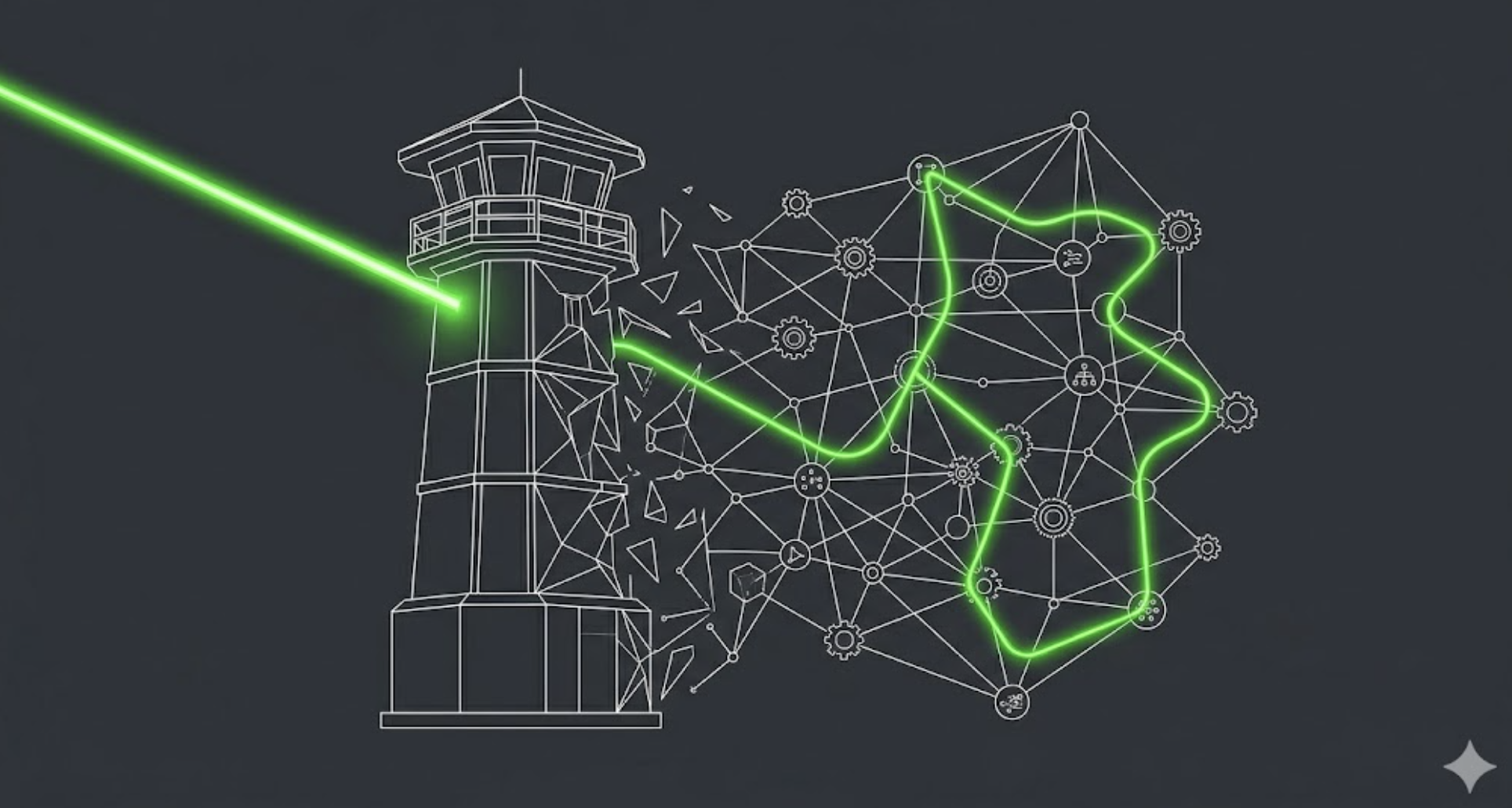
The Latency of External Policing
In the modern enterprise, a structural tension frequently exists between the engineering organization and the risk and compliance functions. Engineering teams are structurally incentivized to maximize deployment velocity and reduce systemic debt. Conversely, Legal and Security are incentivized to mitigate risk, adhere to expanding regulatory frameworks (such as SOC2, GDPR, or the AI Act), and prevent catastrophic liabilities.
When high-velocity engineering collides with risk mitigation, the organization often defaults to friction-heavy governance. While legacy "Change Advisory Boards" have largely vanished from agile environments, they have frequently been replaced by modern equivalents: mandatory InfoSec code reviews, blocked pull requests pending security sign-offs, and extensive pre-launch compliance checklists. This friction tends to produce a dangerous secondary effect: Shadow IT. When the operational cost of compliance slows down a sprint, rational engineers frequently find quiet workarounds, spinning up unauthorized infrastructure or bypassing testing gates, paradoxically creating the exact vulnerabilities the compliance team was hired to prevent.
Foucault and the Architecture of Power
To understand the mechanics of this friction, we might apply the framework of Michel Foucault’s Discipline and Punish. Foucault traces the historical shift from "Sovereign Power" (the visible, public, and often disruptive enforcement of rules by an external authority) to "Disciplinary Power" (the invisible, structural, and continuous observation of individuals).
Foucault utilizes Jeremy Bentham’s concept of the Panopticon, a circular prison design where inmates can be observed by a central tower at any moment, but cannot see the guard. Because they might be watched at any given second, the inmates internalize the rules and police themselves. Foucault argued that modern power operates most efficiently when it is embedded into the architecture itself, rather than applied retroactively through force.
In the corporate technology environment, the siloed Security Reviewer blocking a pull request acts as "Sovereign Power", a visible, external authority that steps in to punish or delay a deployment. The CWO perspective suggests that this is a highly inefficient use of organizational energy. The goal is to transition to an automated, architectural Panopticon, where compliance is an invisible characteristic of the development environment itself.
The Illusion of the Security Gate
When attempting to balance deployment velocity with regulatory adherence, executive leadership generally adopts one of three common architectures, each carrying specific structural limitations:
- The InfoSec Gate (Sovereign Veto): Leadership mandates that specific deployments involving data or infrastructure changes pass through a manual Security or Legal review. While this logically reduces immediate risk, it frequently destroys engineering velocity, leaving code languishing in a queue while a siloed security team attempts to catch up.
- The Retroactive Audit (Panoptic Anxiety): Teams are permitted to deploy rapidly but are subjected to heavy, random compliance audits or external penetration tests after the fact. This approach often leads to expensive, panicked refactoring cycles and a culture of adversarial mistrust between developers and auditors.
- The "Laissez-Faire" Pipeline (Willful Ignorance): Often seen in early-stage growth, the organization prioritizes speed and largely ignores compliance until a major enterprise client demands a SOC2 report. This provides high short-term velocity but introduces existential regulatory risk during the sales cycle.
Foucault’s lens suggests these approaches struggle because they treat compliance as an external force applied against the workflow, rather than an underlying structure that defines the workflow.
Building the DevSecOps Panopticon
To resolve the dialectic between speed and safety, the C-Suite might consider restructuring governance from manual policing to embedded automated architecture:
- Implement "Compliance-as-Code": Translate PDF policy documents into machine-readable code (e.g., using Open Policy Agent or Terraform sentinels). When compliance rules live inside the CI/CD pipeline, the architecture itself rejects non-compliant configurations before they can be deployed. The "guard" becomes an invisible, automated compiler check.
- Platform Security as a Self-Service Primitive: Shift the Security team's core OKRs from "Number of Audits Conducted" to "Adoption Rate of Secure Base Images." If Security provides pre-approved, compliant infrastructure templates, engineers will naturally use them because they represent the path of least resistance. Control is achieved through operational convenience.
- Decentralize the Governance Node: Rather than maintaining a centralized security team that acts as a bottleneck, embed security champions directly within the engineering pods. This shifts the power dynamics; compliance becomes a localized engineering requirement rather than an external legal threat.
Conclusion: The Invisible Guard
A governance model that relies on human reviewers to block software deployments is a legacy of Sovereign Power. The Chief Wise Officer understands that true operational security is structural, not punitive. By embedding compliance into the code itself, organizations remove the friction of the external auditor and allow the architecture to quietly enforce the boundaries of the enterprise.
"He who is subjected to a field of visibility, and who knows it, assumes responsibility for the constraints of power... he becomes the principle of his own subjection."
No spam, no sharing to third party. Only you and me.




Member discussion