
Conway's Law: Shipping the Org Chart
In 1967, a computer scientist named Melvin Conway submitted a paper to the Harvard Business Review. They rejected it, claiming he had not proved his thesis. He published it in an engineering journal instead, and it became one of the most immutable laws of modern business strategy.
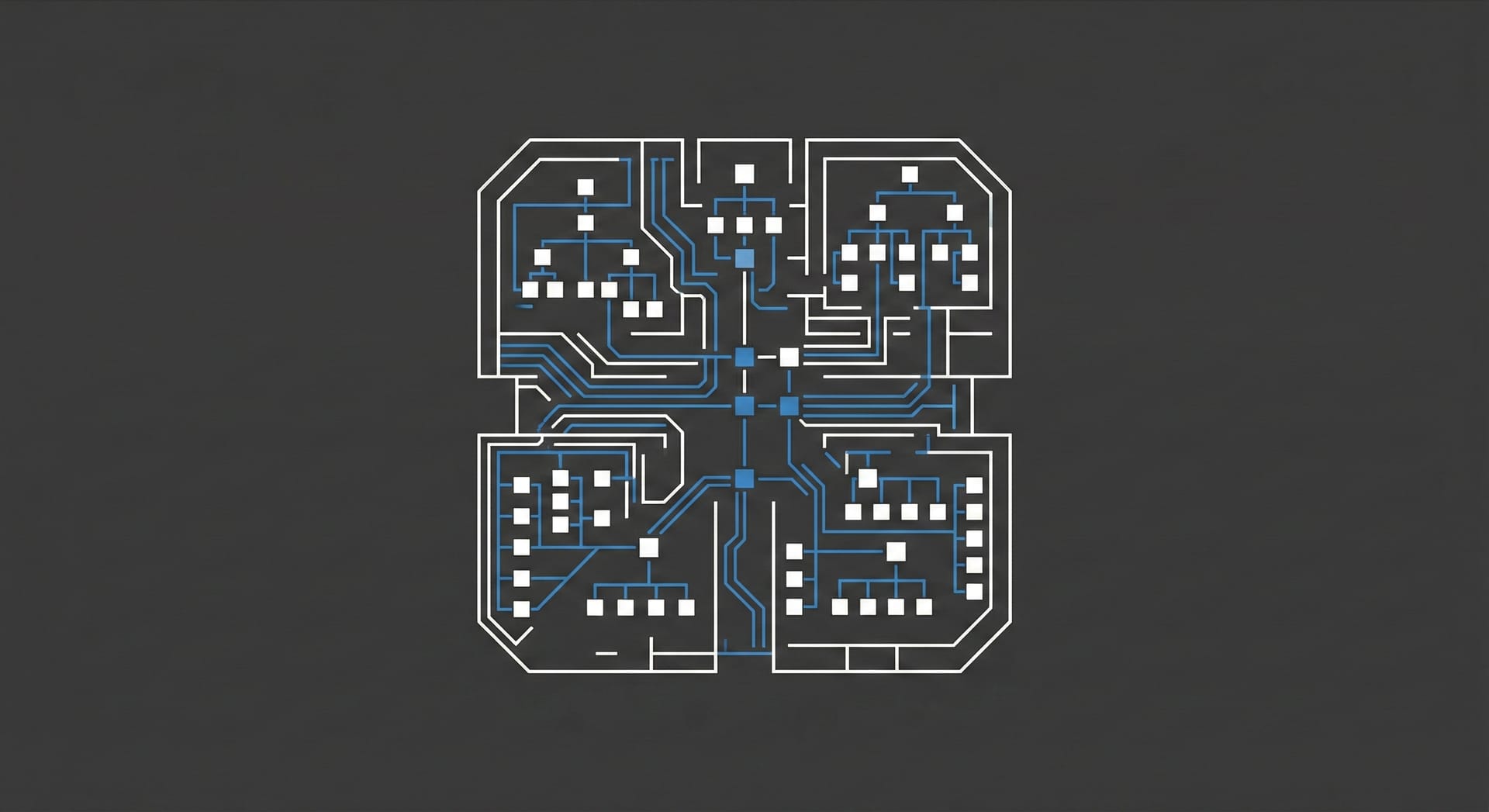
Conway's Law states: "Any organization that designs a system will produce a design whose structure is a copy of the organization's communication structure."
If you want to know why your product is broken, stop looking at the codebase and start looking at the seating chart.
The Compiler of Human Communication
Conway’s original observation was brutally simple. He noted that if you assign a single, highly cohesive team to build a software compiler, they will build a one-pass compiler. If you assign four distinct teams to build a compiler, they will inevitably build a four-pass compiler.
The architecture of the software is forced to mirror the communication boundaries of the humans building it.
If Team A needs to coordinate with Team B, but they are in different time zones, report to different directors, and use different Slack workspaces, the friction of communication becomes too high. To survive, the teams will build an artificial boundary (an API, a separate module, a distinct database) between their pieces of the software so they don't have to talk to each other as much.
The software architecture becomes isomorphic to the communication architecture. The code becomes a fossil record of corporate dysfunction.
The Isomorphism of Dysfunction
This law does not just apply to code; it applies to everything a company produces.
1. The Monolith Trap Legacy banks often struggle to release mobile apps. They want to be agile, but their org chart is a massive, top-down, command-and-control hierarchy. Because every decision must flow up through a single monolithic management structure, the software they produce is a tightly coupled "Monolith." When they try to update a minor feature on the mobile app, it breaks the mainframe accounting software. They cannot ship modular software because they are not a modular organization.
2. The Fragmented Customer Journey A telecommunications company wants a "unified, omnichannel customer experience." But the company is structured into deeply siloed P&L units: The Mobile Division, the Broadband Division, and the Cable Division. Conway's Law guarantees that the customer will receive three different bills, talk to three different support centers, and have to navigate three different portals. The CEO's vision of "unity" is mathematically impossible because the budget and communication lines are fractured.
The Strategic Solution: The Inverse Conway Maneuver
For decades, companies tried to fight Conway's Law. They hired expensive consultants to draw up beautiful, highly decoupled, modern product architectures while leaving the bureaucratic, hierarchical org chart exactly the same. It fails every time. The org chart always wins.
Eventually, the tech industry realized that if you cannot beat Conway's Law, you must weaponize it. This strategy is known as the Inverse Conway Maneuver.
Instead of designing the software architecture you want, you design the organizational communication structure that will inevitably produce the software you want.
1. Evolve to Micro-Teams (Pods) If you want your software to be built of independent, fast, modular components (Microservices), you must first break your massive engineering department into small, independent, cross-functional teams (often called Squads or Pods). A team should have its own product manager, designer, and engineers, and they must be fully empowered to ship without asking a committee for permission. Small, decoupled teams naturally produce fast, decoupled software.
2. Sever Unnecessary Communication Lines In a traditional company, "more communication" is always viewed as a good thing. In Conway's world, forced communication creates tangled architecture. If two teams are constantly in meetings coordinating their releases, they are too tightly coupled. The Chief Wise Officer steps in not to facilitate the meetings, but to redesign the boundaries so the teams no longer need to meet. You optimize for team autonomy, not managerial oversight.
Conclusion: You Ship Your Org Chart
Most executives believe that Organizational Design belongs to HR, and Product Architecture belongs to the CTO.
Conway’s Law proves that they are exactly the same thing. You cannot separate the two. When you add a new layer of middle management, you are simultaneously adding a layer of latency to your product. When you create a silo, you create a broken user experience.
Do not ask your engineers why the system is so complex and hard to navigate. Look in the mirror. You are not shipping a product to your customers; you are shipping your org chart. Make sure it is one they actually want to use.
No spam, no sharing to third party. Only you and me.





Member discussion