
Bio: Plato — The Architect of Vision
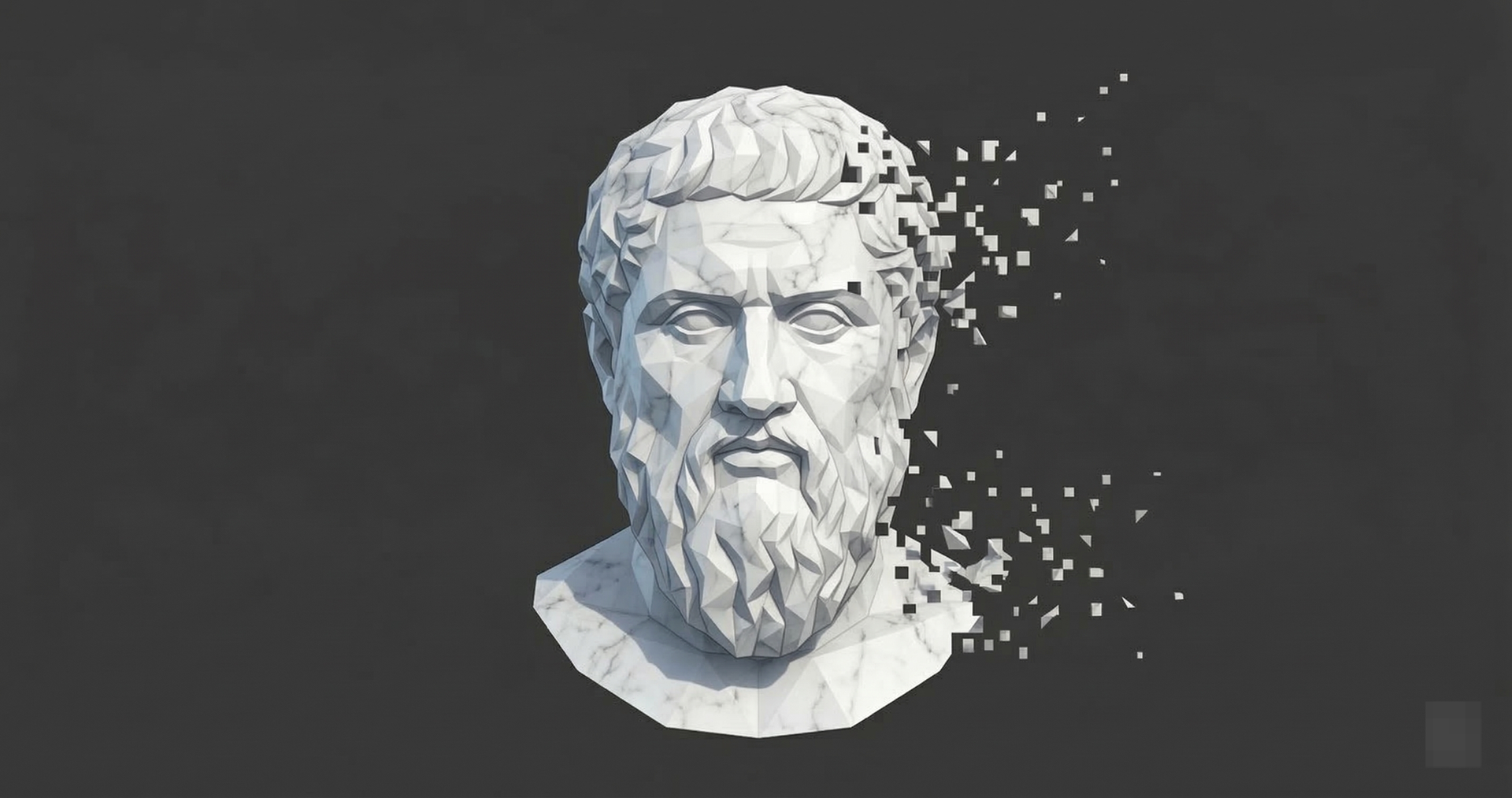
Plato (c. 428/427–348/347 BCE) was an ancient Greek philosopher of Classical Athens who is universally considered the foundational thinker of the Western philosophical tradition. Born into an aristocratic Athenian family during a period of intense political instability, he witnessed firsthand the devastating consequences of both tyrannical oligarchies and unchecked democracies. The profound disillusionment he experienced, culminating in the state-sponsored execution of his mentor, Socrates, precipitated a radical shift in his intellectual trajectory. Recognizing that individual wisdom is precarious and easily silenced by a corrupt state, Plato dedicated his life to an unprecedented epistemological and political project: the systematic pursuit of objective truth and the construction of an enduring institution to cultivate it. In 387 BCE, he founded the Academy, establishing a dynamic intellectual community that would shape philosophical discourse for millennia and serve as the earliest structured academy for higher education in the West.
I. The Biographical Crucible: From Aristocles to the Institutional Visionary
To fully comprehend the structural and pedagogical innovations of the Academy, it is necessary to examine the historical and biographical crucibles that shaped its founder. The individual universally known to history as Plato was born in Athens around 428/427 BCE or 424/423 BCE. His lineage was aristocratic, placing him at the absolute center of Athenian elite society. His father’s family claimed direct descent from the sea god Poseidon, while his mother, Perictione, was related to Solon, the legendary Athenian lawgiver who laid the foundational codes of the city. Plato's given name at birth was Aristocles, in honor of his grandfather. The moniker "Plato", derived from the Greek word platos, meaning "broad", originated as a nickname. Historical sources suggest this nickname may have been bestowed by his wrestling instructor in reference to his robust physical build, or perhaps it referred to the breadth of his literary style or the physical width of his forehead.
Despite this privileged upbringing, Plato's early life was defined by extreme political volatility and civic trauma. His formative years coincided with the catastrophic Peloponnesian War (431–404 BCE), a grinding conflict between Athens and Sparta that drained the city's resources and fractured its political stability. Following the defeat of Athens in 404 BCE, Sparta dismantled the Athenian democracy and installed a ruthless, pro-Spartan oligarchic regime known to history as the Thirty Tyrants. This brutal administration was not composed of distant political figures; it was intimately tied to Plato's own family. The oligarchy included his uncle Charmides and his mother's cousin Critias, both of whom were prominent leaders in the regime.
Due to his aristocratic standing and familial connections, the young Plato was explicitly invited to join this new administration. However, he quickly became entirely disillusioned by the regime's arbitrary cruelty and flagrant violations of justice. The breaking point occurred when the Thirty Tyrants attempted to implicate his beloved mentor, Socrates, in the extrajudicial seizure and summary execution of the democratic general Leon of Salamis, an illegal order that Socrates famously defied at great personal risk.
The subsequent overthrow of the Thirty Tyrants and the restoration of the Athenian democracy in 403 BCE offered a brief, illusory glimmer of hope for Plato’s latent political ambitions. This hope was permanently eradicated in 399 BCE. The newly restored democratic state, deeply paranoid and seeking scapegoats for the city's recent misfortunes, placed Socrates on trial on charges of impiety and corrupting the youth. The subsequent execution of the man Plato considered the wisest and most just of his generation imparted a devastating realization: brilliant individuals can easily be silenced by the state, and direct political action within a fundamentally corrupt system is an exercise in futility. This trauma catalyzed a massive paradigm shift in Plato's strategic thinking. He realized that to preserve, protect, and expand upon his teacher’s intellectual legacy, he could not rely on individual charisma or the fickle whims of the Athenian assembly. The preservation of wisdom required the establishment of an institution.
The Sicilian Expeditions and the Threat of Tyranny
Before he could establish this institution, Plato embarked on an extensive period of travel, seeking knowledge from various philosophical centers across the Mediterranean. Following the death of Socrates, he and other Socratics temporarily relocated to Megara to study with Euclides. His travels eventually took him to Egypt, Cyrene, and, most consequentially, to Syracuse in Sicily around 385 BCE at the invitation of the tyrant Dionysius I.
Plato was immediately repulsed by the staggering decadence, excess, and sensuality of the Syracusan court. However, he formed a deep, lifelong intellectual bond with the tyrant's brother-in-law, Dion, who exhibited a genuine aptitude for philosophy. Plato’s uncompromising insistence on the absolute necessity of virtue, coupled with his vocal disdain for the tyrant's opulent and arbitrary exercise of power, deeply offended Dionysius I. The tyrant's retaliation was swift, severe, and nearly fatal to the history of Western philosophy.
According to ancient biographical sources, reinforced by the recently deciphered carbonized Herculaneum scrolls (specifically Philodemus’s History of the Academy), Dionysius I ordered Plato to be deported and sold into slavery. The philosopher was transported to the island of Aegina, which was, at various points, hostile to Athens, to be sold in the common slave market. (The Herculaneum scrolls have sparked recent academic debate by suggesting this enslavement may have occurred even earlier, either in 404 BCE following the Spartan conquest of Aegina or in 399 BCE immediately after Socrates' death, though the traditional narrative places it during the Sicilian voyage).
Regardless of the precise dating, the historical consensus confirms that Plato was placed on the auction block. Fortunately, he was recognized by a man named Anniceris, often identified as a philosopher of the Cyrenaic school, who promptly ransomed him for twenty to thirty minae, securing his freedom and sending him back to Athens. When Plato's affluent Athenian friends subsequently attempted to reimburse Anniceris for the ransom, Anniceris steadfastly refused the funds. Instead, he insisted that the money be utilized to purchase a small parcel of land in a public garden grove located northwest of the Athenian city walls. This extraordinary sequence of historical events, from profound political disillusionment to the degradation of enslavement and the subsequent liberation through philosophical kinship, provided both the literal real estate and the profound psychological impetus for the foundation of the Academy.
Table 1: The Biographical Crucibles Shaping the Foundation of the Academy.
II. The Architecture of the Academy: The First Institution of Higher Thought
Around 387 BCE, Plato formally established his school in the public Athenian garden that bore the name of the mythical hero Hecademus or Academus. The area, located approximately one mile northwest of the Athenian city center, was deeply steeped in civic and religious history. It contained a sacred grove of olive trees dedicated to Athena, the goddess of wisdom, and had been utilized for gymnastics, athletic festivals, and religious cult activities since the Bronze Age. The statesman Cimon had previously enclosed the precincts with a wall and diverted the river Cephisus to irrigate the dry land, transforming it into a lush, shaded park ideal for intellectual contemplation.
Plato’s architectural and organizational genius lay in his ability to seamlessly merge the public and private dimensions of intellectual life. He utilized the ransom funds to purchase an adjacent private property featuring a house, gardens, and an exedra, a semi-circular architectural recess designed specifically for seated conversations and lectures. He also erected a mouseion, a shrine dedicated to the nine Muses (the goddesses of learning and the arts), which served as the spiritual and communal focal point of the property. While the private residence housed the school's library of books and manuscripts, much of the Academy's daily activity took place in the public park, where members would congregate to converse while walking along the shaded pathways.
Operational Structure: A Dynamic Intellectual Community
The Academy is universally regarded as the first university in the Western world, yet its operational mechanics differed vastly from both modern educational institutions and the practices of contemporary Sophists. The Sophists were itinerant educators who charged fees to teach wealthy youths the art of rhetorical persuasion, often prioritizing the ability to win arguments over the discovery of objective truth.
In stark contrast, Plato's Academy did not charge mandatory tuition, nor did it operate with a strict syllabus, formal enrollment periods, or a grading system. It functioned as a loosely organized, emergent community of independent scholars, mathematicians, astronomers, and philosophers. The community was highly diverse in its intellectual output. Leading thinkers of the era, such as the mathematician Eudoxus of Cnidus, the philosopher Aristotle (who studied there for twenty years), Speusippus, and Xenocrates, all participated in the Academy. Crucially, Plato did not demand adherence to a rigid "Platonic orthodoxy." He actively encouraged a diversity of perspectives, dialectical debate, and the rigorous exploration of alternative views, reflecting Socrates' willingness to test ideas through friction rather than dictating them from authority.
The communal architecture of the Academy was vital to its success. Members engaged in syssitia (communal meals) and participated in an environment where collaborative research and the sharing of intellectual property were the cultural norm. This communal lifestyle fostered a high-trust environment where individuals became intimately familiar with one another's cognitive processes, effectively institutionalizing a baseline of intellectual alignment.
The Epistemological Gatekeeper: The Legend of Geometry
A pervasive and enduring legend regarding the Academy asserts that Plato inscribed a strict, exclusionary warning above its entrance: "Let no one ignorant of geometry enter here" (mèdeis ageômetrètos eisitô mou tèn stegèn). While this phrase has permeated the historical consciousness of Western education, rigorous academic and philological scrutiny reveals it to be historically dubious in a literal, physical sense.
The purported inscription is entirely absent from the extant works of Aristotle, a highly notable omission considering Aristotle lived, studied, and taught at the Academy for two decades and frequently utilized the word ageômetrètos in his own writings (such as in the Posterior Analytics). The inscription first appears in the historical record over a millennium after Plato's death. It is cited by the 6th-century CE Neoplatonic Christian philosophers Joannes Philoponus and Elias of Alexandria in their commentaries on Aristotle, and later by the 12th-century Byzantine scholar Joannes Tzetzes. Earlier 4th-century CE sources, such as the emperor Julian the Apostate and the orator Sopatros, allude to an inscription but demonstrate that the phrase was a later rhetorical invention rather than a physical artifact.
However, despite the lack of physical evidence, scholars universally acknowledge that the phrase perfectly encapsulates the intrinsic spirit and epistemological prerequisites of Platonic pedagogy. The Greek adjective ageômetrètos is a verbal adjective derived from the privative a- and geômetrètos (capable of practicing geometry). Because verbal adjectives ending in -tos often indicate possibility or capacity, the inscription translates more accurately as "let no one inapt to geometry come in". It was a warning targeted at those lacking the cognitive capacity for abstract thought, rather than a ban on those who simply had not yet memorized geometric theorems.
For Plato, mathematics and geometry were not just the study of physical shapes or utilitarian measurements; they were the essential cognitive prerequisites for participating in the highest levels of strategic and philosophical debate. Ancient sources like Sopatros and Tzetzes linked geometry directly to moral concepts, noting that geometry was viewed as the study of "equality/fairness and justice/righteousness". In Book VII of the Republic, Plato argues explicitly that geometry forces the soul to look upwards, drawing the mind towards absolute truth and creating the spirit of philosophy. By moving the student away from a reliance on flawed empirical sensation and toward the use of pure abstract reason, geometry acts as the bridge between the visible world of illusions and the intelligible world of the Forms.
Plato effectively required geometric proficiency to ensure that all participants in the Academy shared a common intellectual standard. To engage in the grueling work of discovering truth, the community first had to master the baseline rules of logic, deduction, and structured thinking.
III. The Epistemological Scaffolding: Scaling the Mechanics of Thought
The paramount challenge facing the modern Chief Wise Officer (CWO) is identical to the challenge Plato faced upon acquiring the grove of Hecademus: How does one scale the capacity for profound thought? Plato understood implicitly that wisdom cannot be forcibly inserted into an individual's head; one cannot simply hand a student a manual of truth. Instead, the leader must design the optimal environment and methodologies for individuals to discover that truth themselves. To scale how the Academy thought, Plato developed, refined, and codified specific methodologies of collaborative inquiry over his lifetime. These methodologies, Elenchus, Dialectic, and Diaeresis (Collection and Division), represent the evolution of his epistemological scaffolding.
1. Socratic Elenchus: The Destruction of False Conceit
In his early developmental period, Plato authored the so-called aporetic or Socratic dialogues (such as the Euthyphro, Laches, and Charmides). These texts are designed not to present a final theory, but to illustrate the method of elenchus, a specific form of negative inquiry, cross-examination, and logical refutation.
The process of elenchus involves examining an interlocutor's confidently stated belief by subjecting them to a relentless series of probing questions. These questions elicit further statements and commitments from the interlocutor. The ultimate objective of the questioner is to demonstrate that the interlocutor's collective discursive commitments are entirely incoherent, contradictory, and logically unsound.
The primary function of the elenchus is destructive, but productively so. It is utilized to break down the reader’s intellectual complacency, ridding them of their false conceits, untested assumptions, and pretensions of knowledge. By systematically refuting false beliefs, the elenchus induces a state of aporia (profound perplexity or cognitive deadlock). For Plato and Socrates, aporia is the absolute necessary prerequisite for genuine learning; a person cannot learn what they falsely believe they already know.
In a modern organizational context, the elenchus is the philosophical ancestor of rigorous corporate stress-testing. Blameless post-mortems, aggressive red-teaming, and uncompromising security code reviews are modern implementations of Socratic refutation. The objective is not to attack the individual, but to aggressively cross-examine the architecture, stripping away developer ego to reveal structural incoherence before a product reaches the market.
2. Platonic Dialectic: The Science of Free Men
As Plato's philosophy matured into his middle and late periods (producing masterworks such as the Republic, Phaedo, and Sophist), he introduced Dialectic as the constructive, positive counterpart to the destructive elenchus. While elenchus is utilized as a method of refutation to clear the ground, dialectic is the positive methodology utilized to obtain substantive doctrine and to ascend toward a true knowledge of reality.
Plato exalts dialectic as the ultimate "procedure of discussion" (Sph. 227A) and the highest conceivable form of human reasoning. In the famous analogy of the Divided Line in the Republic, dialectic is described as the mechanism by which the intellect utilizes hypotheses not as final, unassailable truths, but merely as stepping stones. The dialectician steps from one hypothesis to another until they ascend to a non-hypothetical first principle, the ultimate Form of the Good.
In the late dialogue the Sophist (253d), the character of the Eleatic Stranger defines dialectic as the ability to correctly discern which classes or genera harmonize with one another and which do not. This rigorous, logical categorization of reality is explicitly exalted as the "science of free men" (hē tōn eleutherōn epistēmē). This terminology is crucial: dialectic distinguishes the true philosopher, who deals in absolute, objective being, from the sophist, who deals in relative illusions, linguistic manipulation, and the enslavement of the mind to popular opinion. Dialectic requires participants to interact with absolute goodwill, entirely devoid of envy or malice, continually rubbing names, definitions, and perceptions against one another until the pure truth illuminates the subject.
3. Collection and Division (Diaeresis): Establishing Conceptual Boundaries
In his later dialogues, specifically the Phaedrus, Sophist, and Statesman, Plato formalizes the dialectical process into the highly structured method of Collection and Division (diaeresis). This method was explicitly designed to produce precise, unassailable definitions in terms of necessary and sufficient conditions, ensuring that when two individuals engaged in debate, they were discussing the exact same ontological entities rather than talking past one another.
- Collection (Synagoge): The intellectual process of surveying a multitude of diverse, scattered instances and collecting them into a single, broad general class or genus.
- Division (Diaeresis): The systematic, usually binary, division of that overarching class into sub-kinds. Plato dictates that this division must occur "at their natural joints," comparing the philosopher to a skilled butcher preparing meat, taking care to avoid arbitrary, unnatural fracturing of concepts.
In the Sophist, Plato provides a foundational training exercise for his students by utilizing diaeresis to define a seemingly mundane subject: an "Angler" (a fisherman). The inquiry begins with the broadest possible genus and proceeds through a series of mutually agreed-upon binary choices to locate the specific target.
Table 2: The Method of Division (Diaeresis) applied to the Angler, demonstrating Platonic ontological mapping (Derived from the Sophist).
This highly structured, tree-like system of branching roads forces the inquirer to abstract entirely away from emotional attachments or subjective values. The method demands that the inquirer honors all sub-arts equally to acquire an objective understanding of the kinship among concepts. By requiring divisions to be mutually agreed upon at each node, diaeresis ensures that infinitely complex problems are broken down into universally understood micro-components.
For the modern Chief Wise Officer, diaeresis is the ancient blueprint for data taxonomy, ontology mapping, and the creation of unified product frameworks. A corporate team cannot have a productive debate about product architecture if the engineering and marketing teams are operating with different conceptual definitions of "success" or "engagement." By demanding a shared "geometry" of definitions, the CWO eliminates semantic ambiguity, rendering cross-functional collaboration incredibly fast and frictionless.
IV. The Metaphysics of Leadership: The Forms and the Philosopher-King
Plato's ultimate epistemological goal within the Academy was deeply and inextricably intertwined with his political vision, a vision most famously and comprehensively articulated in his middle-period masterwork, the Republic. Deeply disgusted by the violent corruption of Athenian democracy and the lethal tyranny of oligarchies like the Thirty, Plato posited a radical thesis: a just state could only exist if political power and philosophical wisdom were perfectly united. The state must be ruled by "Philosopher-Kings".
The concept of the Philosopher-King lies at the exact intersection of two critical Greek virtues: sophia and phronesis. Sophia represents theoretical wisdom, intellectual acuity, and the knowledge of eternal, metaphysical truths. Phronesis represents practical wisdom, the lived experience, and the strategic judgment required to navigate the messy realities of human governance. A true Philosopher-King is a leader who has transcended the immediate, noisy shadows of daily political life to apprehend the pure, eternal "Forms" (or Ideas), the abstract, unchanging, perfect blueprints of reality, such as the Form of Justice, the Form of Beauty, and, above all, the Form of the Good.
The Allegory of the Cave and the Educational Ascent
To explain the agonizing, transformative journey required to forge such a leader, Plato presents the most famous metaphor in Western philosophy: the Allegory of the Cave, found in Book VII of the Republic.
Humanity is depicted as a collective of prisoners, chained since birth in a subterranean cave, facing a blank wall. Behind them burns a fire, and between the fire and the prisoners, puppeteers carry objects. The prisoners watch the shadows projected onto the wall, mistaking these two-dimensional, flickering illusions for absolute reality.
For Plato, education is not the Sophistic act of pouring data into an empty mind; it is the agonizing process of unchaining the prisoner and forcing them to turn their entire soul around toward the light. The ascent out of the cave into the sunlit world of true reality (representing the realm of the Forms) is the acquisition of sophia. However, the Philosopher-King cannot remain in the sunlit realm of pure abstraction. Because they possess true knowledge of the Good, they recognize a moral duty to return to the darkness of the cave. They must utilize their acquired phronesis to govern the remaining prisoners justly, attempting to elevate the collective condition.
To achieve this synthesis of theoretical and practical wisdom, Plato outlines an exhaustive, multi-decade curriculum for the guardian class, heavily relying on the disciplines taught within the Academy:
Table 3: The Developmental Stages of the Philosopher-King (Derived from Republic, Book VII).
The defining characteristic of the Philosopher-King is that they rule not out of a pathological desire for power, but out of a solemn sense of duty. Because they have apprehended the ultimate Form of the Good, they are entirely disinterested in the petty accumulations of personal wealth or prestige. They own no private property and receive no exorbitant salary, rendering them functionally immune to the corrupting influence of greed that destroys traditional regimes.
V. The Limits of Implementation: The Sicilian Warning and the Seventh Letter
While the Republic provided a flawless theoretical blueprint for the ideal leader, Plato’s actual historical attempts to implement this vision in the real world proved disastrous. The events in Syracuse expose the profound limitations of applying rigorous philosophical frameworks to subjects who lack the foundational character to receive them. The primary source for this historical episode is the Seventh Letter, an autobiographical epistle addressed to the friends and relatives of Dion following Dion's political assassination.
The Academic Debate on Authenticity
The Seventh Letter is currently the subject of intense, highly polarized academic debate regarding its authenticity. For centuries, its Platonic authorship was occasionally questioned due to perceived stylistic anomalies and the broader ancient tradition of epistolary forgery. In recent decades, prominent Anglophone scholars, most notably Myles Burnyeat and Michael Frede, have forcefully argued against its authenticity. They suggest the letter was composed by a later associate of the Academy or a skilled forger attempting to construct an ex post facto apologia to excuse Plato's political failures and entanglement with tyrants.
Conversely, defenders of the letter, such as Ludwig Edelstein and several modern philologists, maintain that the historical and philosophical contexts strongly support Platonic authorship. They argue that an astute forger could not have replicated the nuanced philosophical digressions present in the text, and note that Plato likely utilized the epistolary genre to compete rhetorically with contemporaries like Isocrates. Regardless of the outcome of the literal authorship debate, the scholarly consensus firmly acknowledges that the Seventh Letter accurately reflects the Academy's orthodox stance on the Syracuse affair, providing indispensable insight into Platonic political methodology and the theory of knowledge transmission.
The Failure of Dionysius II
In 367 BCE, following the death of Dionysius I, Plato’s friend Dion urgently invited the philosopher back to Syracuse to tutor the new tyrant, Dionysius II. Dion possessed a genuine, optimistic belief that if the young Dionysius II could be properly educated in the rigors of philosophy, the massive military and economic power of Syracuse could be transformed into an approximation of the ideal Kallipolis (the beautiful city).
The endeavor failed spectacularly, resulting in political chaos. The root of the failure was cognitive and characterological. Dionysius II viewed philosophy not as a grueling, soul-transforming practice requiring the abandonment of bodily pleasure, but merely as an instrumental tool for prestige, a status symbol to be displayed to impress visiting dignitaries at court. The young king desired the final answers, the ultimate truths, without submitting to the agonizing, decades-long mathematical and dialectical labor required to genuinely achieve them.
In the philosophical digression of the Seventh Letter, the author states explicitly that true philosophical insight cannot be published as a static set of opinions, a rigid handbook, or a convenient "answer key". True knowledge must be born afresh in the soul through the intense friction of collaborative dialogue, rubbing names, definitions, and visual perceptions against one another in goodwill and without envy. Dionysius II lacked the preliminary mathematical training (the geometry), the moral character, and the genuine desire for truth required for this dialectical process. Consequently, frustrated by the demands placed upon him, he exiled Dion, seized his property, and placed Plato under effective house arrest until the philosopher was eventually permitted to return to Athens. Dion later returned to Syracuse with a mercenary army, overthrowing Dionysius II, but was himself assassinated, plunging the city into bloody civil strife.
The catastrophic lesson of Syracuse is paramount for modern organizational design: sophia cannot be mandated from the top down. A leader cannot simply decree a "philosophical culture" or inject visionary thought into a workforce that lacks the foundational character, the collaborative goodwill, and the preparatory frameworks required to sustain it.
VI. The CWO Strategy: Translating Antiquity into Corporate Infrastructure
The exhaustive historical and philosophical analysis of Plato’s Academy yields profound, actionable insights for the executive leadership of modern technology companies. When an executive team transitions from building a product to building an institution, they encounter the exact epistemological problem Plato faced after the death of Socrates: how to ensure that a massive, distributed body of individuals executes with the coherent, visionary genius of the founders.
In modern corporate nomenclature, the executive tasked with solving this cognitive scaling crisis is the Chief Wise Officer (CWO), a role entirely dedicated to optimizing the intellectual operating system of the enterprise. The CWO recognizes that sustainable, generation-defining innovation is not achieved through massive wikis, rigid employee handbooks, or superficial team-building exercises. It is achieved by cultivating a modern equivalent of the Platonic Academy inside the company's walls.
1. Establishing the "Geometry": The Shared Vocabulary
Plato’s purported inscription, "Let none ignorant of geometry enter here," was a non-negotiable mandate for a shared baseline of logical abstraction. In a modern tech enterprise, severe cross-functional friction consistently arises because engineering, product, and marketing teams lack a unified conceptual language. They are effectively practicing what Plato would identify as "sophistry", talking past one another using definitions manipulated for immediate persuasive effect rather than engaging with objective reality.
The first mandate of the CWO is to enforce corporate "geometry." This manifests practically as meticulously documented Design Systems, unified coding standards, shared architectural principles, and an explicit, mathematically sound "North Star" metric. By utilizing the principles of Platonic diaeresis (Collection and Division), the CWO ensures that every team defines their operational terms with necessary and sufficient conditions. When the definition of a "successful deployment," a "qualified lead," or "user engagement" is divided at its natural joints and universally agreed upon, cross-functional collaboration accelerates, free from the drag of semantic ambiguity.
2. Institutionalizing the Dialogue: Elenchus and Dialectic
The Academy thrived on dialectic, the rigorous, respectful, back-and-forth debate required to strip away false assumptions and illuminate the truth. In the world's highest-performing engineering cultures, this dialectical method is heavily formalized and fiercely protected.
- Corporate Elenchus (The Socratic Refutation): Applied practically as rigorous, blameless post-mortems and aggressive red-teaming exercises. The goal is to cross-examine a system failure to find the root cause, systematically stripping away developer ego to reveal structural incoherence without resorting to personal ad hominem attacks.
- Corporate Dialectic (The Constructive Synthesis): Applied as the Request for Comments (RFC) process and peer code reviews. Ideas are hypothesized, tested against peer scrutiny, and refined without envy or malice. Just as the Eleatic Stranger described dialectic as the "science of free men," the RFC process democratizes architecture, ensuring that the most truthful, effective idea survives irrespective of the author's hierarchical rank.
3. Scaling the Vision: The Form of the Good
In the daily, grinding operations of a scaling company, technical teams inevitably become submerged in the tactical noise of Jira tickets, bug fixes, and sprint planning. They become the prisoners staring at the shadows on the cave wall, mistaking immediate, localized performance metrics for the overarching reality of the product.
The CWO must function as the Philosopher-King, exercising both theoretical sophia and practical phronesis. Their primary responsibility is to repeatedly and forcefully pull the organization out of the cave. They must clearly and relentlessly communicate the visionary "Form" of the product, the ultimate, unchanging value proposition the company strives to manifest in the world. By explicitly connecting the granular reality of a specific line of code or a minor UI adjustment to the macro-level "Form of the Good," the CWO imbues daily labor with profound philosophical meaning, ensuring that tactical execution continuously serves the grand strategic vision.
Table 4: Translating Platonic Epistemology into Modern Organizational Design Infrastructure.
The Sicilian Warning for Modern Leaders
Finally, the CWO must heed the dire historical warning of Plato's failure in Syracuse. A visionary culture cannot be superficially superimposed upon a workforce that lacks foundational alignment, or within an executive team that views "philosophy" merely as an instrumental marketing tool. If executives attempt to install "innovation" top-down without investing the grueling time required to cultivate the "geometry" of their employees, they will encounter the corporate equivalent of Dionysius II: a culture that mimics the aesthetic shadows of visionary thinking while remaining fundamentally mercenary, disjointed, and doomed to eventual collapse.
VII. Conclusion: The Ultimate Epistemological Moat
Plato’s transition from the traumatized student of a martyred philosopher to the founding architect of Western academia represents one of the most successful and enduring strategic pivots in human intellectual history. Recognizing that individual brilliance is inherently ephemeral and vulnerable to the violent political vagaries of the polis, Plato built the Academy. It was an institution designed not merely to harbor existing knowledge as a passive repository, but to perpetually generate new knowledge through a rigorously structured, communal methodology.
By demanding a geometric baseline of logical rigor, institutionalizing the relentless friction of dialectical debate, and constantly orienting his scholars toward the transcendent truth of the Forms, Plato created an environment where brilliant people could do their absolute best thinking. The Academy survived in various iterations for centuries, weathering massive political upheavals, regime changes, and military conquests precisely because its strength lay in its operational culture and its epistemological framework, not in a static set of fragile doctrines.
For modern technology companies navigating the intense complexities of the scale-up phase, the lessons derived from antiquity are abundantly clear. Software features can be cloned by a competitor in a matter of months. Supply chains can be replicated. Pricing models can be reverse-engineered and undercut over a single weekend. However, an organizational culture that has successfully internalized the mechanics of a Platonic Academy possesses an unbreakable, un-copyable competitive moat.
When a Chief Wise Officer successfully implements this architecture of vision, forging a community that communicates flawlessly through shared structural definitions, stress-tests ideas constructively without the interference of ego, and aligns daily tactical execution with an overarching, transcendent product goal, they achieve something far greater than market dominance. They do not merely scale a profitable corporate entity; they build an enduring institution of thought.
No spam, no sharing to third party. Only you and me.




Member discussion