
Bio: Karl Popper — The Black Swan Slayer

Introduction: The Epistemology of Corporate Validation
When modern executives enter a corporate boardroom to pitch a new strategic initiative, the immediate reflex of the leadership team is to demand rigorous validation. Contemporary organizational culture is fundamentally engineered to seek confirmation. Leadership seeks comprehensive case studies, extensive market research, and highly detailed financial projections designed to mathematically confirm that the proposed strategic idea will succeed in the marketplace. Executives are systematically trained throughout their professional careers to isolate data that supports their underlying hypotheses. Corporations routinely deploy external consultants, market analysts, and data scientists for the express purpose of verifying that executive intuition is factually correct.
In the 1930s, the Austrian-British philosopher Karl Popper identified that this precise cognitive instinct, the desperate, inherently human search for confirming evidence, is the primary adversary of objective intellectual and societal progress. Popper recognized that building an intellectual framework or a corporate strategy solely on the pursuit of confirmation results in a fragile, unfalsifiable architecture. A theory, or a business model, that is structurally designed to interpret every incoming data point as a confirmation of its own brilliance is fundamentally flawed.
Popper fundamentally rewired the scientific method, shifting the paradigm of human knowledge acquisition from verification to falsification. He posited that the ultimate objective of a rigorous thinker is not to permanently prove a theory true, but to ruthlessly and systematically attempt to prove it false. Within the context of modern enterprise management and strategic risk, Popper’s philosophy serves as the ultimate antidote to corporate hubris. For the modern strategic leader, conceptually framed here as the Chief Wise Officer, Popper provides a methodological framework for building robust organizations that survive uncertainty by actively hunting for their own vulnerabilities.
The Intellectual Crucible of Red Vienna
To understand the magnitude of Popper’s contribution to epistemology and strategy, it is necessary to examine the turbulent historical and intellectual context from which his ideas emerged. Karl Raimund Popper was born in Vienna on July 28, 1902, during the twilight years of the Austro-Hungarian Empire. He was born into an upwardly mobile family of Jewish descent; his father, Dr. Simon Popper, was a prominent lawyer with a profound interest in the classics, possessing a massive personal library of over 10,000 volumes. This highly intellectual, "bookish" upbringing deeply influenced the younger Popper, fostering a lifelong engagement with complex ideas, classical music, and rigorous philosophical inquiry.
Following the collapse of the Austro-Hungarian Empire at the end of the First World War, Vienna became a cauldron of revolutionary political and scientific ideas. In 1919, at the age of sixteen, Popper temporarily embraced Marxism, swept up in the revolutionary socialist fervor that consumed Austria. However, this intellectual flirtation with radical utopianism was brief and ended in profound psychological trauma. After witnessing a violent clash where unarmed socialist youths were killed by the police, an event catalyzed by communist agitators who viewed the sacrifice of human life as a necessary step toward historical revolution, Popper developed a profound, lifelong revulsion for Marxist ideology, doctrinaire radicalism, and the justification of political violence. This early, visceral disillusionment with absolute ideological certainty became the psychological bedrock of his later philosophical work.
Disenchanted with orthodox schooling, Popper left the local Realgymnasium early, matriculating at the University of Vienna as a guest student to attend wide-ranging lectures in mathematics, theoretical physics, philosophy, and psychology. His early career was eclectic; he briefly worked in street construction (a physically demanding job he eventually had to abandon) and subsequently trained as a professional cabinetmaker. He eventually returned to formal academia, earning his doctorate in psychology in 1928 under the supervision of Karl Bühler. His dissertation, which focused on the methodological foundations of cognitive psychology, featured Moritz Schlick, the founder of the highly influential philosophical group known as the Vienna Circle, as the second chair of his thesis committee.
During this interwar period, Vienna was arguably the intellectual capital of the world, serving as the incubator for psychoanalysis, individual psychology, and the booming political theory of Marxism. However, despite his close proximity to these movements, Popper refused to formally align himself with the Vienna Circle or the dominant psychoanalytic schools. Instead, he positioned himself as their most formidable internal critic, serving as an "official opposition" to their foundational methodological tenets. In 1934, he published Logik der Forschung (later translated and expanded in 1959 as The Logic of Scientific Discovery), a seminal text that systematically dismantled the prevailing scientific methodologies of his era and established his international academic reputation.
The Problem of Demarcation and the "Fake" Sciences
The core of Popper’s philosophy, and its most direct application to modern strategic thought, lies in his elegant solution to what he formally termed the "Problem of Demarcation". In the early 20th century, the dominant philosophical paradigm, championed by Moritz Schlick and the logical positivists of the Vienna Circle, was "verificationism". This doctrine held that a statement is only cognitively meaningful if it can be empirically verified through observational data.
Popper fundamentally disagreed with this premise. He recognized that the empirical sciences needed to be demarcated not just from pure mathematics and logic, but from sophisticated metaphysical systems and pseudosciences that masqueraded as rigorous empirical science. Popper argued that the positivists' reliance on the "verifiability criterion" actually destroyed the demarcation line, subsuming empirical science into the very metaphysics they sought to eliminate.
The Closed Hermeneutic Circles of Freud, Adler, and Marx
In the intellectual ferment of post-WWI Vienna, the young Popper closely observed four revolutionary, paradigm-shifting theories: Albert Einstein’s Theory of General Relativity, Karl Marx’s theory of history, Sigmund Freud’s psychoanalysis, and Alfred Adler’s individual psychology. Popper even possessed firsthand experience with these psychological frameworks, having briefly cooperated with Alfred Adler in his social guidance clinics in the working-class districts of Vienna.
Despite their massive popularity, Popper quickly grew deeply suspicious of the theories of Marx, Freud, and Adler. Their proponents seemingly possessed the uncanny ability to explain any conceivable human behavior or historical event. Followers of these disciplines saw confirming evidence for their theories everywhere; the world was entirely full of verifications.
Popper identified that within the framework of Freudian or Adlerian psychoanalysis, any human action could be interpreted to fit the underlying theory perfectly. To illustrate this fatal flaw, Popper utilized a famous hypothetical scenario involving a drowning child. If a man sacrificed his life to leap into a turbulent river to rescue the drowning child, Freudians could explain the heroic act as a case of psychological "sublimation". Conversely, if the exact same man intentionally murdered the child by drowning them in the river, the same Freudians could explain the horrific act as a case of psychological "repression". Adlerian psychologists could similarly explain both contradictory actions through the lens of individuals attempting to overcome inherent "inferiority feelings".
Popper realized that theories capable of explaining every possible outcome actually explain nothing at all. They are permanently immunized against contradictory evidence because every imaginable state of affairs can be retroactively reconciled with their foundational premises. When predictions fail, adherents of Marxism or psychoanalysis simply introduce untestable ad hoc hypotheses to save the theory from collapse, a deeply unscientific process Popper termed "reinforced dogmatism". Finding confirming evidence is the easiest endeavor in the world if a theory is sufficiently vague and adaptable.
The Einstein Revelation and the Logic of Falsifiability
Albert Einstein provided the ultimate epistemological contrast to the closed hermeneutic circles of psychoanalysis and Marxist historicism. Einstein had recently published his Theory of General Relativity, which posited a revolutionary understanding of gravity not as a force, but as a curvature of spacetime. Crucially, Einstein's theory made highly specific, mathematically precise, and wildly risky predictions regarding how the immense gravitational pull of massive objects would bend the light of distant stars.
During the solar eclipse of 1919, the British astronomer Arthur Eddington led a scientific expedition to the island of Príncipe to empirically test Einstein’s prediction. Popper, along with his small circle of fellow students in Vienna, was profoundly thrilled by the implications of this experiment. Unlike the theories of Freud and Adler, Einstein's prediction was a cliff jump. Einstein’s theory was exceptionally "risky"; if the starlight did not bend at the exact mathematical angle predicted by his equations, the entire theoretical edifice of General Relativity would be instantly and definitively destroyed.
The light bent exactly as predicted, and the theory survived. For Popper, this historic event represented a definitive lightbulb moment. It clarified the fundamental difference between ideological dogma and actual, rigorous science: Epistemological Risk.
A true scientist does not spend their life looking for confirming evidence to prove they are right. Instead, they advance a bold, risky hypothesis and spend all their intellectual energy attempting to break it. Popper thus proposed "Falsifiability" as the necessary and sufficient criterion for the demarcation of science. To be ranked as scientific, a system of statements must be logically capable of conflicting with conceivable empirical observations. A theory must theoretically prohibit certain outcomes; the more it prohibits, the stronger the theory.
The Problem of Induction and the Asymmetry of the Black Swan
Popper's formulation of falsifiability provided a novel and elegant solution to the philosophical "Problem of Induction," which had plagued philosophy since it was famously articulated by the Scottish philosopher David Hume in the 18th century.
Hume had rigorously demonstrated that inductive reasoning, the cognitive process of deriving universal laws from a finite series of specific, repeated observations, is logically unjustifiable. Hume argued that just because the sun has risen every day in the past does not logically guarantee it will rise tomorrow; our belief that it will is merely a psychological instinct born of custom and habit, not a product of rational logic.
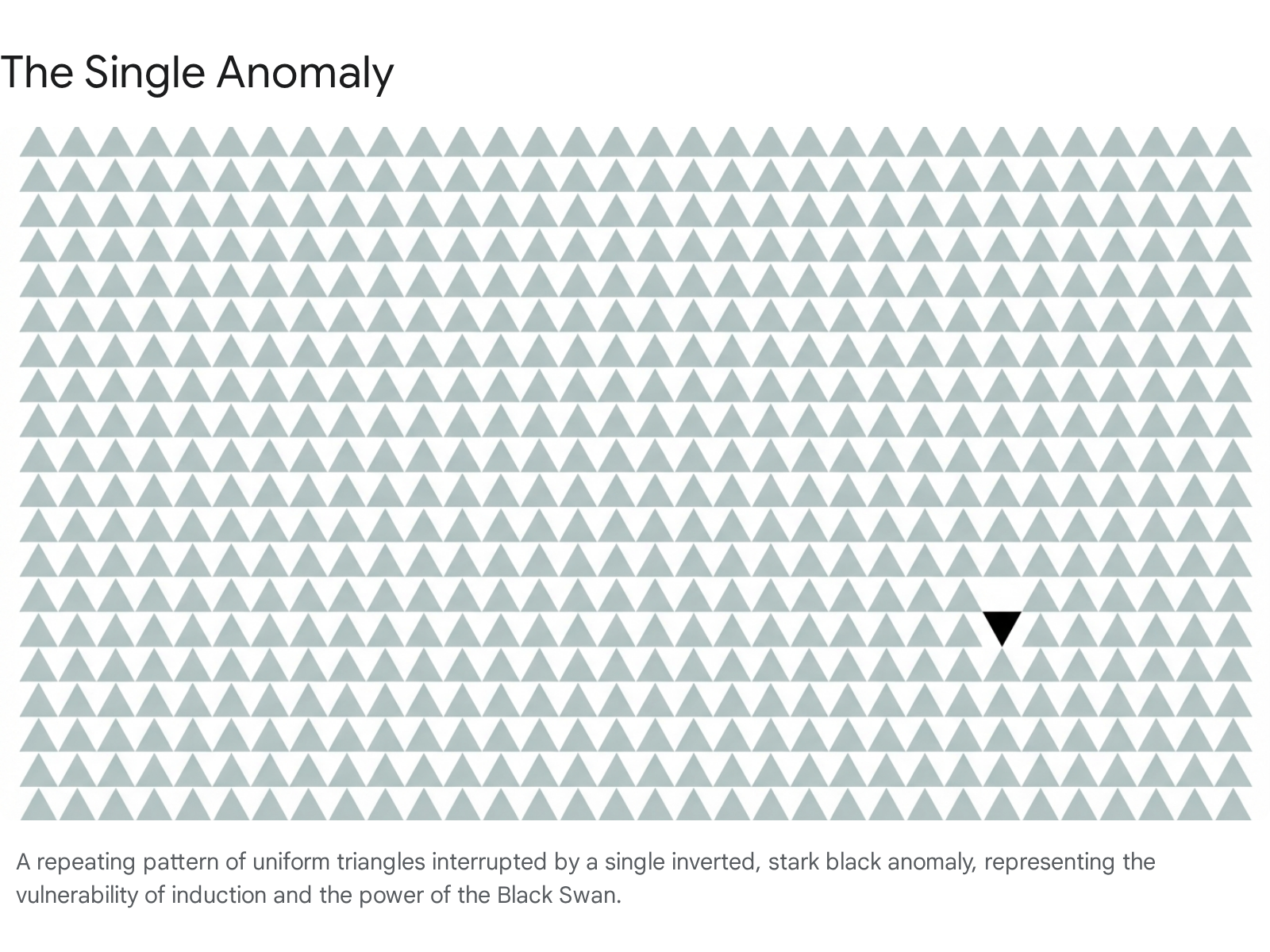
To illustrate this profound logical vulnerability, Popper utilized the classic philosophical metaphor of the Black Swan. For thousands of years, Europeans had only ever observed white swans. Relying on this massive volume of empirical data, they formed a highly "data-driven" inductive scientific theory: "All swans are white". They possessed millions of data points confirming this hypothesis. Every time an ornithologist observed a new white swan, their confidence in the universal theory grew.
However, Popper pointed out a fatal logical flaw inherent in this approach: no amount of confirming observational data, however voluminous, is logically sufficient to verify a universal generalization. You can observe ten million white swans, but that massive dataset still does not definitively prove that all swans are white. However, the discovery of a single black swan, which actually occurred when Dutch mariners reached Australasia in 1697, is logically sufficient to definitively prove the universal statement false.
Popper highlighted a profound logical asymmetry: verification requires infinite confirming observations, while falsification requires only a single, rigorous refuting observation.
Consequently, Popper boldly declared that induction is a myth and that genuine science does not actually use it. Instead, human knowledge grows through a process he called "Critical Rationalism", a rigorous cycle of deductive trial and error, commonly referred to as "conjecture and refutation". Human beings propose bold, imaginative theories (conjectures) to solve problems, and then subject them to the most severe empirical testing possible (refutations). Knowledge survives and progresses only insofar as it successfully resists our best, most aggressive efforts to falsify it. The strategic lesson for the modern enterprise is profound: objective truth cannot be confirmed by the sheer volume of data; it can only survive through rigorous, continuous stress-testing.
The Divergence of the Black Swan: Popperian Logic vs. Talebian Risk
In modern corporate strategy, finance, and risk management, the concept of the "Black Swan" has become entirely ubiquitous. However, its application is frequently misunderstood in the boardroom due to a significant divergence between Karl Popper's original epistemological usage and the modified definition popularized by the quantitative analyst and essayist Nassim Nicholas Taleb in his highly influential 2007 book, The Black Swan: The Impact of the Highly Improbable.
Understanding this distinction is critical for leaders attempting to implement Popperian frameworks, as the two thinkers use the same metaphor to attack different vulnerabilities in human reasoning.
The Popperian Anomaly
For Karl Popper, the Black Swan was a strictly logical metaphor deployed to solve the problem of induction and establish the criterion of demarcation. It demonstrated a structural asymmetry in how we acquire knowledge. Popper's focus was exclusively on the logical structure of scientific theories and language.
Crucially, a Black Swan in the original Popperian sense does not need to be an event of catastrophic magnitude or massive societal impact; it simply needs to be a valid, empirical observation that contradicts the formal predictions of a universal law. The discovery of a black bird in Australia did not crash global financial markets or topple governments, but it definitively destroyed the biological premise that "all swans are white." For Popper, the Black Swan is merely the falsifying data point, the anomaly that forces us to abandon a cherished theory and construct a better one.
The Talebian Outlier
Nassim Taleb, while a self-professed admirer of Popper’s philosophy, fundamentally repurposed the metaphor to address the specific realms of probability, statistical modeling, economic risk, and historical dynamics. Definitionally, a Talebian Black Swan must possess specific characteristics that go far beyond mere logical falsification:
- Unpredictability: The event is an extreme outlier. It lies vastly outside the realm of regular expectations, and nothing in the past convincingly points to its possibility.
- Extreme Impact: The event carries a disproportionate, massive consequence, either highly beneficial or entirely catastrophic.
- Retrospective Predictability: Human beings inherently construct post-hoc rationalizations to make the event appear predictable and explainable in hindsight, masking the true nature of the uncertainty.
Taleb's primary target is not logical positivism, but the "Ludic Fallacy", the dangerous misapplication of games of chance (like rolling dice or casino games, where probabilities are known, bounded, and computable) to real-world complexities. Taleb argues that modern financial risk management is dangerously, almost criminally reliant on Gaussian (Normal) distributions, which inherently ignore the possibility of "fat tail" catastrophic events.
Standard statistical tools map well to environments with physical limits (like predicting the average physical height of a human population), but they fail catastrophically in highly complex, scalable environments (like wealth distribution, technological innovation, or global financial markets). In these complex systems, a single outlier can render the entire historical sample size utterly irrelevant.
While academic statisticians frequently criticize Taleb for allegedly misrepresenting the sophistication of modern econometrics and erecting straw-man arguments against applied statistics, his core intervention aligns seamlessly with Popperian skepticism. Both thinkers demand profound intellectual humility in the face of uncertainty. Where Popper warns that our scientific theories are never permanently verified, Taleb warns that our corporate risk models are structurally blind to the massive anomalies that actually dictate the course of history.
Exile, The Open Society, and the LSE Legacy
The theoretical purity of Popper's philosophy was soon tested by the horrific realities of mid-20th-century European politics. The rapid rise of Nazism and the looming annexation of Austria forced Popper, due to his Jewish heritage and political vulnerability, to desperately seek refuge abroad. With the assistance of prominent academics, he secured a position as the sole lecturer in philosophy at Canterbury University College in Christchurch, New Zealand, relocating there with his wife in 1937.
His time in New Zealand was marked by profound intellectual isolation and significant institutional friction. He faced limited access to philosophical source materials and was actively discouraged from conducting research by university authorities, who rigidly viewed research as a "theft" of his paid lecturing time. Despite these immense obstacles, Popper produced his massive, two-volume magnum opus of political philosophy, The Open Society and Its Enemies (1945). He explicitly described this rigorous historical dismantling of Plato, Hegel, and Marx as his personal "war effort" against the philosophical roots of totalitarianism and fascism.
Finding a publisher for such a massive and controversial work during wartime proved incredibly difficult. It was only through the dedicated intervention of his close friends, the art historian Ernst Gombrich and the prominent Austrian economist Friedrich Hayek, that the manuscript was secured a publishing deal with Routledge in 1945.
Hayek, who remembered Popper from a brilliant 1936 seminar Popper had delivered at the London School of Economics (LSE) titled “The Poverty of Historicism,” became Popper's greatest academic champion. The massive critical success of The Open Society so impressed Hayek that he aggressively persuaded the leadership at LSE to offer Popper a Readership. Popper arrived in London in 1946, leaving New Zealand to establish the Department of Philosophy, Logic and Scientific Method at the LSE.
Popper's presence fundamentally altered the institution's intellectual trajectory, embedding a world-class emphasis on the philosophy of natural science within a school traditionally focused on the social sciences and economics. He was subsequently appointed Professor of Logic and Scientific Method at the University of London in 1949, was knighted by the British Crown in 1965, and remained a towering, active intellectual figure until his death in 1994.
Historicism and the Mechanics of Corporate Change Management
Popper’s application of falsifiability extended far beyond the hard sciences; he deployed it with devastating effect in sociology, political philosophy, and historical analysis. In The Poverty of Historicism and The Open Society and Its Enemies, he delivered a fatal critique of "Historicism", the philosophical belief that human history is governed by discoverable, immutable laws that dictate its inevitable future course.
Marxism, for instance, relies entirely on historicism, positing a deterministic, unavoidable historical progression from capitalism to socialism, and finally to a communist utopia. Popper argued that the discovery of such historical laws is logically impossible. Human history is a singular, unique process. Unlike physics, where natural laws can be tested through repeatable, isolated laboratory experiments, a theory purporting to map the entire, unrepeatable trajectory of human civilization cannot be empirically tested. If a historicist prediction fails, the theory cannot be systematically altered and retested in the same way a scientific theory can.
Utopian vs. Piecemeal Social Engineering
From his devastating critique of historicism, Popper derived a crucial framework for organizational intervention, distinguishing sharply between "Utopian Social Engineering" and "Piecemeal Social Engineering".
Utopian engineering attempts to redesign society (or an entire complex corporation) holistically, based on a grand, predetermined, abstract blueprint.1 Popper vehemently opposed this approach, arguing that it inevitably requires authoritarian control and inevitably leads to catastrophic, unintended consequences. When a massive, all-encompassing intervention fails, the sheer complexity of the systemic change makes it impossible to isolate which specific variable caused the failure. The feedback loop is destroyed, rendering error elimination impossible.
Conversely, Popper advocated forcefully for "Piecemeal Social Engineering". This method involves making small, targeted, incremental adjustments to institutions, carefully monitoring the outcomes, and retaining the ability to quickly reverse course if the intervention yields negative results.
In contemporary corporate change management, Utopian engineering is analogous to the "spasmodic campaigns" and massive restructuring initiatives that frequently paralyze modern organizations, such as sweeping, top-down culture-transformation programs, massive mergers, or radical, company-wide reengineering mandates driven by abstract executive visions. These massive corporate shifts often fail spectacularly because their sheer scale prevents the isolation of failing variables.
Applying Popperian piecemeal engineering requires corporate leaders to treat organizational changes as localized, testable hypotheses. By implementing changes incrementally, companies can engage in trial and error, ensuring that negative feedback from the operational reality can falsify the management's theoretical assumptions before systemic, company-killing damage occurs. (It should be noted, however, that some modern organizational sociologists argue that deeply dysfunctional, failing systems occasionally require adapted "many-pieces-at-once" engineering if incremental delay produces deeper systemic harm, demonstrating the ongoing evolution of Popper's framework for extreme crisis scenarios).
The Three Worlds Ontology and Corporate Knowledge Management
To explain how human knowledge exists, scales, and evolves objectively, Popper developed a highly sophisticated metaphysical framework known as the "Three Worlds" ontology, moving decisively beyond traditional Cartesian dualism (the split between mind and matter). This framework is highly relevant for understanding knowledge management, intellectual property, and strategic continuity within modern corporate environments.
Popper divided reality into three distinct but interacting realms:
- World 1 (The Physical): The physical world. This encompasses all physical objects, energy, chemical processes, and biological entities, explicitly including the physical structure of the human brain.
- World 2 (The Subjective): The subjective, mental world. This is the realm of human consciousness, subjective experiences, emotions, memories, and psychological dispositions to act.
- World 3 (The Objective): The realm of objective knowledge and the products of the human mind. This includes scientific theories, mathematical theorems, languages, works of art, computer software, and institutional structures.
Popper’s radical philosophical insight was that World 3 possesses an autonomous, objective reality. While World 3 artifacts (like a published book, a software algorithm, or a corporate strategy deck) are originally created by human consciousness (World 2) and subsequently embodied in physical forms (World 1), their logical content exists independently. For example, the logical contradictions within a complex financial projection model exist objectively in World 3, whether or not the financial analyst (World 2) has realized they are there.
Evolutionary Epistemology in the Enterprise
Crucially, World 3 interacts with World 1 exclusively through the mediation of World 2. A corporate strategy (a World 3 object) is interpreted by an executive's mind (World 2), which then directs physical organizational restructuring, hiring, and capital deployment (World 1).
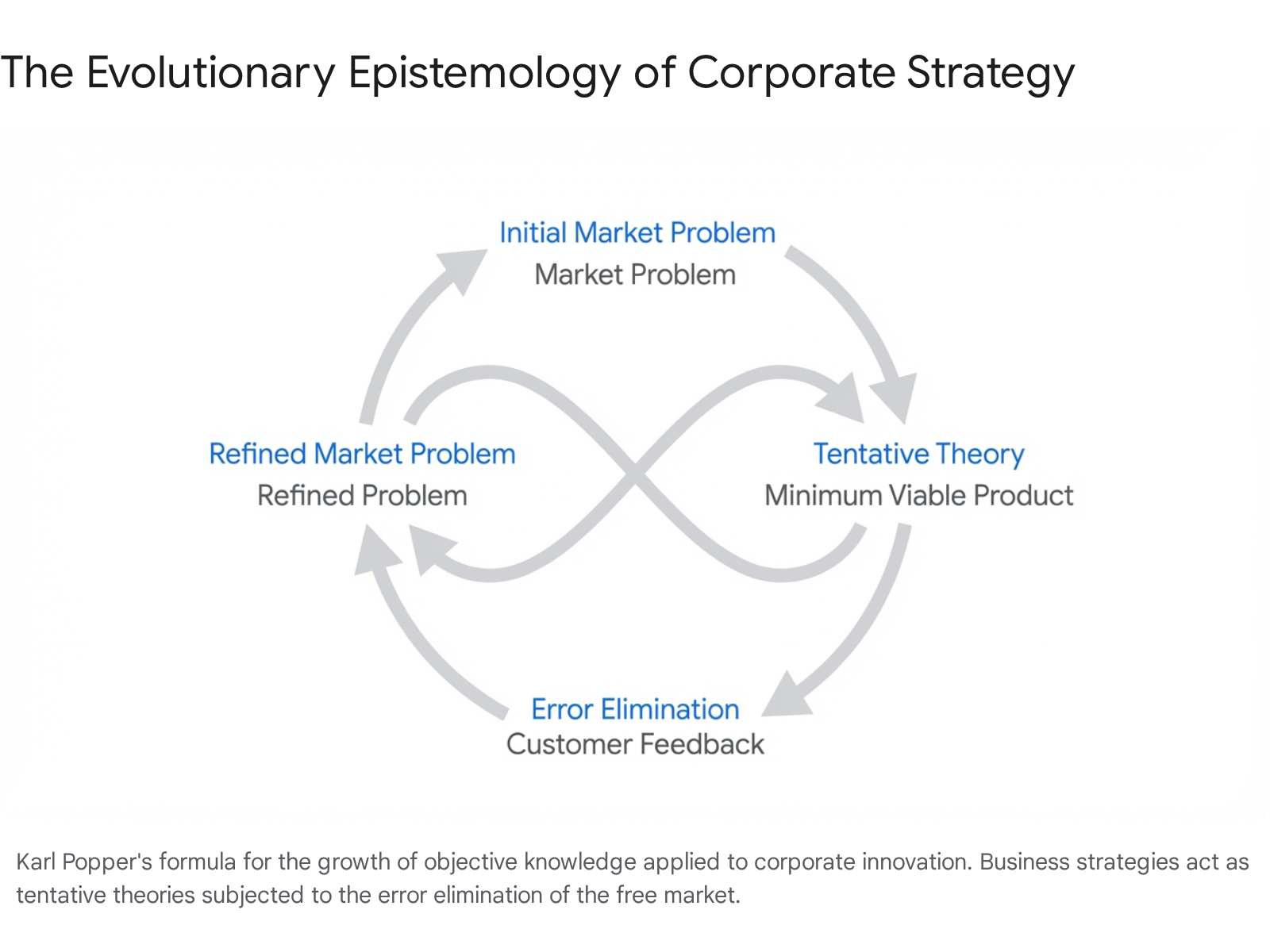
In this framework, knowledge grows autonomously through a rigorous evolutionary process of trial and error. Popper formalized this growth using the following schema: P1 -> TT1 -> EE1 -> P2
Here, an initial Problem (P1) is addressed by a Tentative Theory (TT1). This theory is then subjected to Error Elimination (EE1) through critical testing and attempted falsification. This process inevitably gives rise to a new, deeper, more nuanced Problem (P2), and the evolutionary cycle continues.
For modern enterprises, this schema illustrates that corporate strategy is never a finalized, verified truth. A business model is merely a Tentative Theory (TT1). The market acts as the ultimate, unforgiving mechanism of Error Elimination (EE1). Organizations that deliberately shield their strategies from market falsification stunt their intellectual growth, preventing the discovery of higher-order problems (P2) that drive true innovation and market dominance.
George Soros and the Financial Metaphysics of Reflexivity
The transition of Popper’s philosophy from abstract epistemology to high-stakes, real-world financial strategy is perhaps best exemplified by the career of billionaire investor and philanthropist George Soros. Soros studied under Popper at the LSE in the late 1950s, actively choosing the philosopher as his tutor after being profoundly influenced by the anti-totalitarian arguments of The Open Society and Its Enemies.
While studying classical economic theory alongside Popper's philosophy, Soros was struck by a glaring, irreconcilable contradiction. Classical economics, particularly the foundational theory of general equilibrium, postulated a state of "perfect competition" based on the assumption that market participants possess perfect knowledge. Yet, Soros’s immersion in Popperian falsification had taught him that human understanding is inherently imperfect, that induction is a myth, and that empirical truth cannot be known with absolute certainty.
To resolve this contradiction, Soros developed his "General Theory of Reflexivity," which fundamentally challenges the efficient-market hypothesis. In standard equilibrium theory, asset prices accurately reflect underlying economic fundamentals, and non-equilibrium fluctuations are dismissed as mere random noise. Reflexivity, however, posits a powerful two-way feedback loop between cognitive understanding and objective reality.
Soros argued that financial markets always present a distorted picture of reality because participants act on biased perceptions rather than objective facts. Crucially, these biased perceptions (World 2) actually influence and alter the underlying economic fundamentals (World 1) they are attempting to price. This self-reinforcing pattern explains the creation of massive market bubbles and their subsequent crashes; the market does not tend toward a stable equilibrium but constantly oscillates through reflexive boom-bust cycles.
Soros utilized this applied critical rationalism to become one of the most successful hedge fund managers in financial history. The most famous, high-profile application of this philosophy occurred during "Black Wednesday" in 1992, when Soros heavily shorted the British Pound.45 He correctly recognized that the Bank of England's artificial peg of the pound within the European Exchange Rate Mechanism was a flawed, unfalsifiable "theory" upheld by political dogma rather than underlying economic reality. By aggressively betting against it, Soros forced the falsification of the monetary policy, breaking the Bank of England and generating over a billion dollars in profit in a single trade.
Despite his staggering financial success, Soros remained strictly adherent to Popperian fallibilism. He recognized that his own investment theses were highly susceptible to error and bias. In a colorful, somatic display of falsification, Soros reportedly utilized sudden onset back pain as an intuitive heuristic to signal that an underlying flaw existed in his portfolio's logic, prompting him to instantly liquidate positions and rethink his hypothesis rather than stubbornly holding onto a failing theory.
Strategic Execution: Building the Falsifiable Organization
Integrating Karl Popper’s critical rationalism into enterprise strategy fundamentally shifts how a corporation innovates, manages risk, and structures its internal governance. The traditional model of corporate strategy, which relies on gathering inductive market research to "prove" a business plan will work, is inherently vulnerable. It encourages "strategic falsification" in the pejorative sense, where managers engage in active deception, concealment, and equivocation to manipulate data to fit the mandated corporate narrative, effectively immunizing a failing strategy against reality to protect their careers.
To survive in highly complex, uncertain environments (where Talebian Black Swans reside), leadership must build an epistemologically sound, "falsifiable organization." The Chief Wise Officer flips the traditional corporate script: an organization must be built to hunt black swans, not white ones.
The Lean Startup as Applied Critical Rationalism
The most prominent contemporary translation of Popperian logic into business strategy is the Lean Startup Methodology (LSM), popularized in the software development and high-growth entrepreneurship communities.
LSM explicitly rejects the traditional, inductive "business plan" model, which relies on predicting the future. Instead, it views every new business model, product feature, and market assumption as a temporary, highly vulnerable hypothesis. Because these hypotheses are generated under conditions of extreme market uncertainty, they must be rigorously subjected to falsification.
This is executed through the creation of a Minimum Viable Product (MVP). The MVP is not merely an early, unpolished version of a product; it is a dedicated mechanism for empirical testing designed to validate or invalidate the riskiest assumptions of the business model as rapidly and cheaply as possible. If the market data contradicts the hypothesis, the organization executes a "pivot", a structured course correction representing Popper's "error elimination" phase.
Academic reviews of LSM note its direct historical antecedents in Popper's falsification theory and the scientific method's reliance on deductive reasoning and null hypothesis testing. By prioritizing continuous learning, iterative processes, and rapid feedback loops over rigid, long-term planning, the Lean Startup actively hunts for the falsifying data point (the localized Black Swan) before vast amounts of capital and engineering resources are deployed.
Institutionalizing Skepticism
For large, established corporations, adopting critical rationalism requires overcoming significant cultural and cognitive barriers. Bounded rationality, groupthink, and rigid hierarchical authority often suppress critical voices and mask structural failures. To counter this, strategic leaders must institutionalize skepticism through specific operational practices:
1. The Pre-Mortem ("Kill the Company" Exercise)
Also known as a Pre-Mortem, this exercise requires gathering the leadership team before launching a major initiative and stating: "It is three years from now, and this project was a catastrophic failure that bankrupted the company. What happened?" Rather than asking a team to forecast why a project will succeed (which triggers confirmation bias), this exercise forces the team to reverse-engineer the exact mechanisms of failure. It shifts cognitive pathways away from confirmation and toward the rigorous identification of vulnerabilities, hunting the falsifying data point before the market finds it.
2. Reward the Falsifiers
In typical corporate cultures, the individual who exposes fatal flaws in a high-profile initiative (often the CEO's pet project) is penalized as a disruptive pessimist or viewed as "not a team player." A Popperian organization must actively protect and incentivize the skeptics. If an engineer mathematically proves that a proposed feature will crash the server, or an analyst proves a financial model is structurally unsound, they should be celebrated for saving the company millions in technical debt and strategic drift. An organization must protect the individuals who bring them the black swans.
3. Test the Riskiest Assumption First
When building a startup or a new product line, organizations typically default to building the easy, predictable components first, accumulating a false sense of momentum (hunting white swans). Critical rationalism demands the opposite. Identify the single most dangerous, unproven assumption upon which the entire business model rests, and test that component immediately. Try to falsify the business model as cheaply and quickly as possible.
Conclusion: The Humility of Science as a Strategic Advantage
Karl Popper died in 1994, leaving behind an intellectual legacy that extends far beyond the academic philosophy of science; he provided a universal, robust operating system for navigating uncertainty. By dismantling the long-held myth of induction and establishing falsifiability as the ultimate benchmark of rigorous thought, Popper demonstrated that absolute certainty is a dangerous illusion.
In the boardroom, the relentless pursuit of confirming data is not merely an epistemological error; it is a fatal strategic liability. A corporate strategy that cannot definitively answer the question, "What specific evidence would you need to see to admit that this idea is a failure?" is not a strategy at all. It is a dogma, a religion permanently insulated from reality and uniquely vulnerable to the Black Swans that dictate the fate of global markets.
The integration of critical rationalism, reflexivity, and piecemeal social engineering into corporate governance demands profound intellectual humility.2 It requires leaders to view their most cherished business models as mere tentative theories, awaiting the unforgiving error elimination of the free market. Ultimately, competitive advantage does not belong to the organization that can generate the most data proving it is right, but to the organization that is structurally built to be the fastest to realize when it is wrong.
No spam, no sharing to third party. Only you and me.



Member discussion