
Bio: Aristotle — The First Pragmatist and the Operational Blueprint
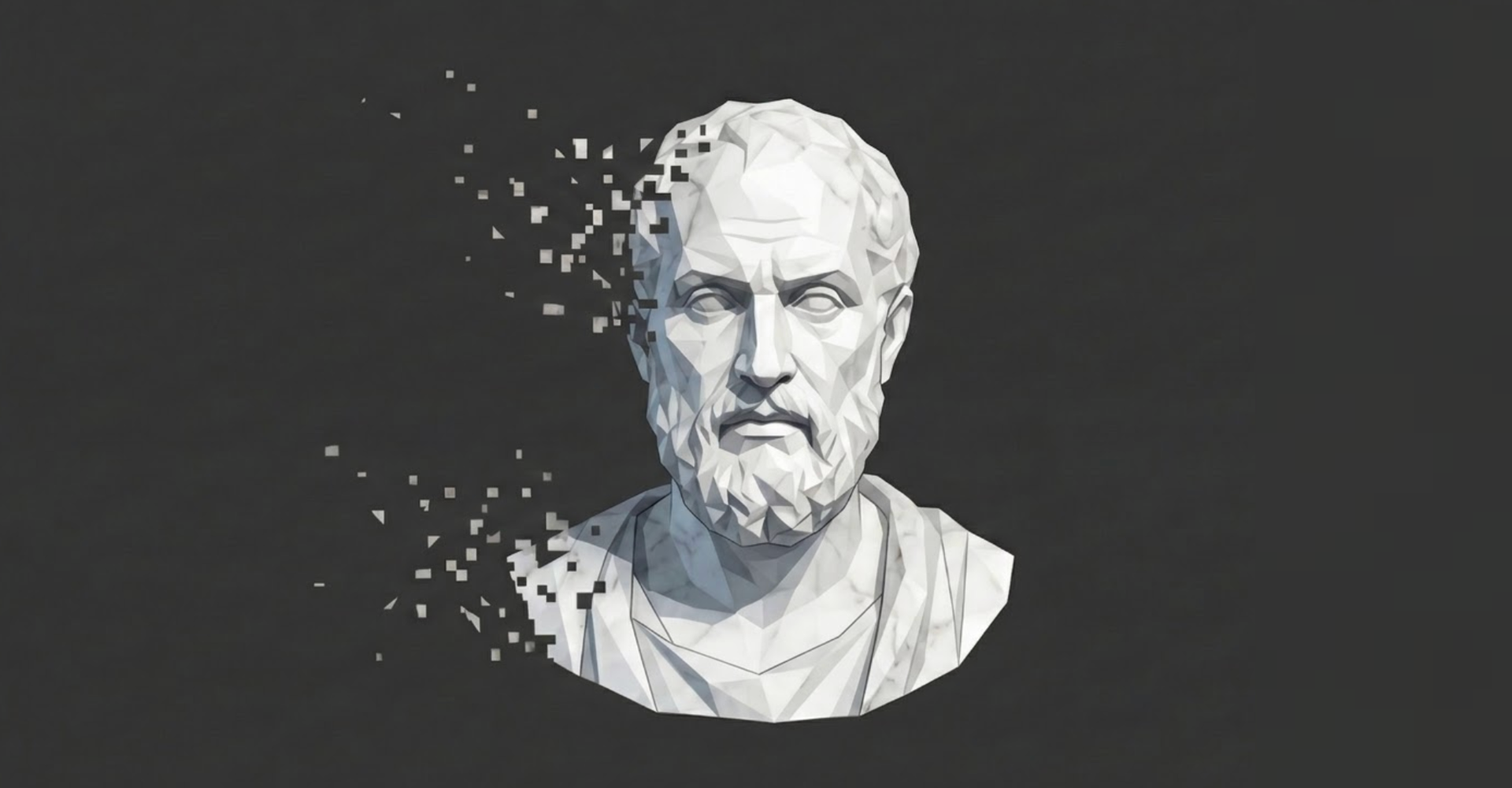
Born in 384 BCE in Stagira, a coastal town in northern Greece, Aristotle stands as one of the most towering intellects in human history and the foundational architect of the empirical method. For two decades, he studied at the Academy in Athens under Plato, absorbing the heights of mathematical deduction and Platonic idealism. Yet, as his own philosophical framework matured, Aristotle realized that contemplating abstract, transcendent perfection was no longer sufficient. To truly comprehend reality and operate effectively within it, he had to look down at the physical, observable world.
This monumental philosophical schism, the transition from staring at the heavens to getting one's hands dirty in the soil, birthed systematic biology, formalized logic, and established a grounded approach to ethics and political science. It also provides a flawless historical analogue for a critical transition required in modern organizational leadership. For the last twenty years, the global market has been obsessed with the "Visionary Founder", modern Platonists who draft flawless strategic roadmaps on pristine whiteboards, operating in a conceptual vacuum. But as any seasoned executive knows, a perfect whiteboard drawing survives exactly zero seconds of contact with actual users.
To bridge the profound gap between theoretical intent and physical execution, modern enterprises are increasingly relying on the operational counterbalance of a Chief Wise Officer (CWO). By exploring Aristotle’s biography, his revolutionary departure from Platonic metaphysics, and his systemic approaches to logic and practical wisdom, a rigorous blueprint emerges. It is a definitive guide for grounding abstract corporate vision in practical, empirical reality.
Biographical Context: From the Academy to the Lyceum
To understand the philosophical shift from abstract theory to physical reality, we must trace the geographical and intellectual journey of Aristotle. Born in a town in the Chalcidice peninsula, Aristotle was immediately immersed in an environment that valued empirical observation. His mother, Phaestis, hailed from a wealthy family on the island of Euboea, while his father, Nicomachus, served as the personal physician to King Amyntas of Macedon. Crucially, Nicomachus claimed descent from the Asclepiads, devotees of Asclepius, the Greek god of healing. The Asclepiad tradition placed a heavy premium on physical anatomy and biological reality, instilling in Aristotle a foundational appreciation for the physical sciences that would forever separate him from purely speculative philosophers.
Both of Aristotle's parents died when he was young, leaving him in the care of Proxenus of Atarneus. At the age of seventeen or eighteen, Aristotle traveled to Athens to study at Plato's Academy. He remained there for two decades, absorbing the heights of Platonic idealism and engaging deeply with the dialectical methods of his mentor. During this time, the Academy trained students heavily in mathematics, rhetoric, and pure theoretical deduction. However, following Plato's death in 347 BCE, the leadership of the Academy passed to Plato's nephew, Speusippus. Disillusioned or perhaps seeking a new intellectual frontier, Aristotle departed Athens, traveling first to Assos on the coast of Asia Minor and subsequently to the island of Lesbos.
The period spent in Assos and Lesbos was profoundly transformative and represents the birth of biological science. Collaborating with his colleague Theophrastus, Aristotle effectively originated the systematic study of biology. While Theophrastus concentrated on botany, Aristotle turned his attention to zoology and marine biology, spending countless hours studying the tidal pools of the Pyrrha lagoon (now the Gulf of Kalloni). He abandoned the purely deductive reasoning favored by the Academy and adopted an inductive, hands-on approach. He dissected marine life, meticulously categorized the biological world, and recognized that true excellence requires action and observation, not merely a perfect blueprint.
In 343 or 342 BCE, this period of isolated scientific inquiry was interrupted when Philip II of Macedon summoned Aristotle to Pella to tutor his young son, the future Alexander the Great. This intersection of philosophy and absolute power provided Aristotle with a unique opportunity to apply his political and ethical theories to an emerging empire. Historical records indicate that Aristotle advised Alexander extensively on statecraft, though they frequently clashed on matters of cultural assimilation. Aristotle, reflecting traditional Hellenic views, maintained a strict dichotomy between Greeks and non-Greeks. He advised Alexander to lead the Greeks as a general but to treat the "barbarians" (non-Greeks) as subjects, akin to plants or animals. Alexander, operating as a visionary expansionist, rejected this ethnocentric rigidity. He actively incorporated foreign troops, married into Persian nobility, and attempted to fuse Greek and Persian cultures. This friction serves as an early historical example of a visionary leader discarding theoretical advice when it conflicted with the practical realities of imperial expansion, though Aristotle's broader teachings on logic and governance left an indelible mark on Alexander's administration.
In 335 BCE, Philip II rebuilt Stagira (which he had previously destroyed), and Aristotle returned to Athens after an absence of roughly twelve years to establish his own educational institution, the Lyceum. Here, Aristotle collected and curated what became the first European library in history. Furthermore, throughout his military campaigns, Alexander the Great sent plant and animal specimens back to his former tutor, allowing Aristotle to establish the first zoo and botanical garden in recorded history. The Lyceum stood in stark contrast to Plato's Academy. Whereas the Academy prioritized abstract forms, the Lyceum functioned as a prototype for the modern empirical research university. It was deeply practical, focusing on biology, physics, ethics, politics, and poetry. The Lyceum encouraged students to explore the natural world through direct observation and systematic study, facilitating the exchange of real-world knowledge. This structural shift from the Academy to the Lyceum perfectly mirrors the necessary organizational shift within the modern enterprise: transitioning from the visionary ideation of a founding CEO to the rigorous, data-driven operational execution overseen by a Chief Wise Officer.
Metaphysics and the Rejection of the Perfect Form
The fundamental philosophical schism between Plato and Aristotle centers on the nature of reality and the location of truth. Plato’s Theory of Forms posited that the physical world is merely a flawed, mutable shadow of a higher, transcendent dimension where perfect, abstract "Forms" exist. For Plato, true knowledge (episteme) could only be achieved through rational contemplation of these eternal Forms. Because the physical world is constantly changing, Plato believed empirical observation could only yield opinions (doxa), rendering physical work and observational science inherently inferior to pure, abstract reasoning.
Aristotle fundamentally disagreed, believing that the only reality that matters is the one directly in front of us. He systematically dismantled Plato's metaphysical dualism through several logical critiques, the most potent of which is known as the "Third Man Argument". Aristotle argued that if a physical man and the ideal Platonic Form of Man share a common characteristic (i.e., "humanness"), there must logically be a third Form that encompasses both the physical man and the original Form of Man to explain their similarity. This logic necessarily dictates a fourth Form to encompass the first three, a fifth, and so on, leading to an infinite regress. By applying Platonic logic to actual existence, Aristotle demonstrated that the Theory of Forms collapses under its own weight, rendering it an unhelpful model for understanding reality.
In place of Plato's transcendent Forms, Aristotle introduced the doctrine of hylomorphism. Hylomorphism asserts that every physical object is a composite of matter (hyle) and form (eidos), which together constitute a unified substance (ousia). For example, a wooden table consists of wood (its matter) and the design or function of a table (its form). Crucially, Aristotle argued that you cannot separate the form from the matter; they coexist symbiotically in the natural world. Form does not exist in a transcendent, untouchable cloud; it exists precisely where it meets the physical material.
This metaphysical pivot holds profound implications for modern organizational strategy. A purely Platonic approach to business involves the C-Suite drafting perfect, abstract roadmaps, assuming that the theoretical elegance of the strategy guarantees its success in the market. The Aristotelian perspective, embodied by the CWO, recognizes that a strategic vision (the Form) is entirely meaningless unless inextricably bound to the operational reality of the company (the Matter). Excellence does not reside in the formulation of the blueprint; excellence resides entirely in the physical manifestation of the action. A strategy only becomes real when it is executed by human capital, constrained by server infrastructure, and validated by user engagement.
The Biological Paradigm: Observation Over Deduction
To fully comprehend Aristotle's commitment to physical reality, we must examine his groundbreaking biological research. Aristotle's writings on biology constitute the first systematic works in the history of science, forming roughly a quarter of his surviving corpus. These works include the History of Animals (Historia Animalium), Generation of Animals, Movement of Animals, Progression of Animals, and Parts of Animals.
Aristotle recognized that a priori reasoning alone was insufficient for understanding the natural world; theoretical explanations had to be ruthlessly squared with observable facts. This allowed him to resolve the paradox of inquiry posed in Plato's Meno. The Meno paradox suggested that inquiry is either unnecessary (if you already know the object) or impossible (if you do not know what you are looking for). Aristotle circumvented this philosophical trap by arguing that perceptual experience and direct observation provide an initial grasp of the target, which then directs further systematic inquiry toward scientific knowledge.
His biological method utilized a highly disciplined, two-stage process. The first stage was the hoti investigation, which translates to "the fact". This was a factual investigation preliminary to the search for causes, focusing entirely on systematically collecting data regarding animal anatomy, physiology, and behavior. Only after the hoti phase was exhaustively complete did Aristotle permit the inquiry to move to the dioti investigation, which translates to the "reason why". The dioti phase involved identifying the causal mechanisms that explained the observed facts.
This rigorous empirical method is vividly demonstrated in his Historia Animalium, particularly in his studies of embryogenesis. Centuries before the advent of modern instrumentation or controlled laboratory settings, Aristotle conducted systematic observations of chick embryos. By carefully opening eggs on successive days of incubation, he recorded the precise chronology of morphological changes. At Book VI, Chapter 3 of the Historia Animalium, he notes that on the critical fourth day after the egg has been laid, the heart is visibly beating and serves as the origin of the blood vessels. By the twentieth day, he observed that the chick vocalizes within the shell, and he accurately detailed the complex anatomical structures of the umbilical cords, noting how one leads to the surrounding chorion-like membrane and the other to the yolk.
This level of visceral, hands-on observation was unprecedented in the ancient world and remained unmatched until the 16th century. Aristotle refused to sit in an academic vacuum theorizing about biological perfection. He named over 500 species of birds, mammals, and fish; he described the internal anatomy of over a hundred animals; and he physically dissected around 35 different species. He observed that octopuses change color when disturbed, and he defined five major biological processes: metabolism, temperature regulation, information processing, embryogenesis, and inheritance.
The translation of this method to the modern C-Suite is direct and uncompromising. The CWO demands the end of abstract strategy. If the VP of Product wishes to pivot the roadmap because a new feature "feels right intuitively" or aligns with a macro-industry trend, the CWO enforces the Aristotelian standard: the hoti must precede the dioti. The executive team is banned from making high-stakes decisions based purely on gut feelings or clean theoretical models. The CWO demands to see the empirical, physical user data. They look at the server logs, they talk to the angry churned users, and they analyze the actual physical reality of the business before attempting to deduce the reason why the market is behaving a certain way.
Epistemology: American Pragmatism vs. Aristotelian Realism
Because of this intense focus on the practical, the observable, and the real-world application of ideas, modern commentators, and the premise of the user's initial draft, frequently label Aristotle as "The First Pragmatist". While this is a highly effective rhetorical device for contrasting his methods with the idealism of Plato, it requires careful, academic qualification to ensure philosophical accuracy.
In the formal study of epistemology, "Pragmatism" refers to a specific American philosophical tradition that originated in the 1870s, championed by thinkers such as Charles Sanders Peirce (widely considered the true first pragmatist), William James, and John Dewey. American Pragmatism asserts that the truth, meaning, or value of a concept lies entirely in its practical consequences, its utility, and its ability to solve problems. Pragmatists generally view language and thought as tools for action rather than mechanisms that "mirror" an objective, independent reality. If a theory does not contribute to practical success or social progress, a strict pragmatist argues it holds little value.
Aristotle, conversely, was a foundational scientific realist and an empiricist. Empiricism is the epistemological view that true knowledge comes primarily from sensory experience and physical evidence, contrasting with the rationalist view that knowledge can be derived through innate ideas or pure logic. Aristotle explicitly stated that all knowledge begins with the senses, firmly cementing his empiricist credentials.
However, unlike modern American pragmatists, Aristotle did not believe a concept was true merely because it was useful. He believed in objective, essential truths that exist independently of human utility. He engaged in scientific inquiry to uncover the fundamental nature of reality, pursuing knowledge for its own sake as a manifestation of human excellence. Therefore, while Aristotle advocated for "practical wisdom" (phronesis) in human affairs, classifying him as a true pragmatist conflates his ethical and political advice with his metaphysical realism.
For the Chief Wise Officer, this academic distinction is highly relevant. The CWO operates with a "pragmatic" mindset in the colloquial sense, prioritizing execution, operations, and tangible results over abstract ideation. However, following the true Aristotelian model means the CWO does not merely accept whatever hack or shortcut works in the short term (a strictly utilitarian approach). Instead, the CWO seeks to uncover the objective, underlying reality of the organization's mechanics. The goal is to build a system aligned with the fundamental truths of the market and the technology, ensuring long-term, sustainable excellence rather than short-term practical survival.
The Analytical Engine: Categorization and the Organization of Knowledge
To manage the overwhelming complexity of empirical data, an executive needs a rigorous analytical framework. Aristotle provided the blueprint for this through his profound desire to categorize the world. His foundational work in logic is collected in six treatises collectively known as the Organon, which translates to "instrument" or "tool". These texts, Categories, On Interpretation, Prior Analytics, Posterior Analytics, Topics, and On Sophistical Refutations, represent the first independent writings on logic and set the groundwork for formal reasoning.
Within this collection, the treatise Categories stands as a monumental achievement in knowledge organization. Aristotle rejected simplistic binary classification systems (dichotomies). He argued that repeatedly dividing natural kinds in half (e.g., dividing all animals strictly into terrestrial and aquatic, and then attempting to divide aquatic animals into blooded and bloodless) creates logical paradoxes and fails to account for the overlapping complexities of the real world.
Instead, Aristotle introduced a comprehensive taxonomy detailing the kinds of being that exist. He advanced a set of ten top-level categories by which anything in existence can be classified, understood, and predicated.
Even today, the influence of Aristotle’s Categories is felt in computer science, information architecture, and Knowledge Organization Systems (KOS). Modern database schemas, object-oriented programming hierarchies, and semantic ontologies all trace their lineage back to Aristotle's effort to tame the chaos of raw information. For the CWO, applying this Aristotelian rigor means refusing to accept vague operational metrics. When a systemic failure occurs, it cannot be explained away with abstract language. The issue must be categorized accurately, is it a failure of Quantity (insufficient bandwidth), a failure of Relation (broken API integration), or a failure of Time (timeout errors)? Precision in categorization is the prerequisite for precision in execution.
Systemic Architecture: The Doctrine of the Four Causes
Beyond the static categorization of what things are, Aristotle developed a comprehensive theory of causality to explain how things change and come into existence. For Aristotle, scientific inquiry consists of the causal investigation of reality; to truly know something is to know its causes. He committed to a form of causal pluralism, asserting that there are four primary and irreducible kinds of causes necessary to fully explain any phenomenon. This framework, known as the Doctrine of the Four Causes, is outlined in his Physics and Metaphysics, and provides an unparalleled architecture for strategic management and operational alignment.
When applied to the corporate environment, the Four Causes prevent leadership from developing blind spots, forcing a holistic view of how a product or strategy is actually built.
A purely visionary founder frequently fixates exclusively on the Final Cause (the ultimate mission to change the world) and the Formal Cause (the beautifully designed product roadmap). The Aristotelian CWO understands that without rigorous, uncompromising attention to the Material Cause (do we actually have the server capacity and budget to scale this?) and the Efficient Cause (do we have the specific engineering talent and deployment pipelines required to build it?), the Formal strategy will inevitably collapse.
Martin Heidegger later echoed this Aristotelian framework when discussing the essence of technology, noting that all four causes are co-responsible for bringing a concept into reality. If any single cause is deficient, the entity fails to actualize. By demanding that the executive team account for all four causes before approving a strategic pivot, the CWO ensures that abstract intent is matched by operational capability.
The Intellectual Virtues and the Mechanics of Phronesis
Having established the metaphysical and causal frameworks necessary for analyzing the external world, Aristotle turned his attention inward to the human mind and its capacity for decision-making. In Book VI of the Nicomachean Ethics, Aristotle provides a masterclass on the rational soul (to te logon echon), dividing it into two distinct parts: the scientific part (to epistêmonikon), which contemplates necessary and unchanging truths, and the calculating part (to logistikon), which contemplates contingent realities, things that "could be otherwise," such as human behavior and market dynamics.
Within this framework, Aristotle identifies five intellectual virtues that enable the soul to attain truth: Nous (Intellect/Intuition), Episteme (Scientific Knowledge), Sophia (Theoretical Wisdom), Techne (Craft/Art), and Phronesis (Practical Wisdom or Prudence).
Understanding the precise distinctions among these virtues is arguably the most critical component for defining the epistemology of modern executive leadership.
The distinction between Techne and Phronesis is paramount. Techne is concerned entirely with making (poiêsis); its end goal is a separate, external product, such as a physical tool or a software application. Phronesis, however, is concerned with doing (praxis); the action itself, and the strategic or ethical rightness of that action within a complex, highly contingent context, is the end goal.
While organizations rightly celebrate the Techne of their developers who write the initial code, and the Sophia of their visionary founders who cast the long-term vision, systemic corporate survival depends entirely on Phronesis. Phronesis integrates intuition with deep deliberation. It is the ultimate executive virtue because it tempers abstract principles with contextual reality.
For example, a company may have a strict procedural rule regarding deployment pipelines. However, during a catastrophic server outage, following the rule exactly might destroy the company. It is Phronesis that allows an executive to adjudicate the risk, overriding the static rules of the organization to preserve the overarching health of the system. Recent academic literature in business ethics and management emphasizes that Phronesis is the psycho-moral integrator that allows leaders to make "judgment calls" at the intersection of conflicting legal, ethical, and organizational frameworks. The Chief Wise Officer is, by definition, the institutional embodiment of Phronesis.
Ethics, the Doctrine of the Mean, and Corporate Culture
Plato believed that identifying the abstract concept of the "Good" was sufficient; he assumed that to know the good was inevitably to do the good. Aristotle fundamentally disagreed. He famously argued in the Nicomachean Ethics that the purpose of studying ethics is not just to acquire theoretical knowledge of what goodness is, but to actually become good. Goodness is an active condition, a disposition (hexis) developed through continuous habituation, practice, and action.
In a corporate context, a beautifully written "Core Values" document on a company wiki is a Platonic ideal. It is, by itself, meaningless. A company’s culture is not defined by its stated intentions; it is defined by exactly what its employees repeatedly do every single day. If the corporate values state "We move fast," but the deployment pipeline requires four layers of managerial approval, the culture is objectively slow. Action supersedes intent.
Central to Aristotle’s ethical framework is the Doctrine of the Mean (often referred to as the "Golden Mean"). Aristotle posited that moral virtue is an intermediate state between two extremes, one of excess and one of deficiency. Virtue requires finding the optimal balance tailored to the specific context, a task that relies entirely on Phronesis to execute effectively.
This framework translates directly into the management of organizational culture and individual leadership traits:
The Doctrine of the Mean resists rigid, puristic rules, acknowledging the profound changeability of human experiences and market conditions. The Aristotelian executive understands that optimizing a company does not mean maximizing every single trait. Maximizing speed leads to massive technical debt and rashness; maximizing caution leads to stagnation and cowardice. Operational excellence is found in the precise, continuously calibrated equilibrium of the Mean.
Bios Theoretikos vs. Bios Praktikos
Aristotle’s exploration of ethics and human excellence culminated in an ongoing philosophical tension between two modes of living: the Bios Theoretikos (the contemplative life) and the Bios Praktikos (the practical, political life). In Book X of the Nicomachean Ethics, Aristotle suggests that the contemplative life, dedicated to the pursuit of pure knowledge and theoretical wisdom, is the highest form of human existence because it exercises the divine spark of reason and requires less external equipment.
However, he also recognizes the inescapable reality that human beings are not pure intellects; they are embedded in physical, social realities that demand the Bios Praktikos. While the visionary CEO may operate primarily in the realm of Bios Theoretikos, gazing at the horizon and contemplating the perfect future state of the industry, the organization itself exists in the messy, frictional reality of the present. The CWO operates within the Bios Praktikos, dealing with resource allocation, human conflict, and tactical problem-solving.
Effective leadership requires the active reconciliation of these two lives. As ancient texts suggest, the philosopher must eventually engage with the empire. A visionary who refuses to engage with practical realities becomes increasingly irrelevant and isolated, while a purely tactical manager lacking theoretical vision will steer the company aimlessly. The optimal corporate structure institutionalizes both, creating a vital, symbiotic relationship between contemplative strategy and practical execution.
Political Philosophy: The Enterprise as a Polis
Aristotle's ethical theories are inextricably linked to his political philosophy. In his treatise Politics, he asserts that the human being is by nature a "political animal" (zoon politikon). He argued that individuals outside of a structured state are either beasts or gods; humans can only achieve their ultimate purpose, eudaimonia, or holistic human flourishing, within the structured community of the polis (the city-state). The polis does not exist merely for basic economic exchange or mutual defense; its highest telos (purpose) is to provide the conditions under which its citizens can live a good, virtuous, and fulfilling life.
When adapting Aristotelian philosophy to modern organizations, the corporation acts as the contemporary polis. Consequently, the ethical responsibility of the executive team is not merely to maximize shareholder value in a vacuum, but to construct a corporate environment that actively facilitates the professional and human flourishing of its employees. According to this framework, an Aristotelian leader must ask: "What form of social contract would allow all our members to develop their full potential to make their greatest contribution to the whole?".
To determine how best to govern the polis, Aristotle undertook a massive empirical study of existing constitutions. He categorized governance structures into three correct forms (where the rulers act for the common good) and three deviant forms (where the rulers act entirely for their own self-interest).
While Aristotle acknowledged that a Kingship led by a perfectly virtuous philosopher-king might theoretically be ideal, his pragmatic understanding of human nature recognized the severe dangers of consolidating power. In the real world, such systems rapidly decay into Tyranny. This mirrors the corporate risk where a structure dominated by a singular, unchecked visionary founder devolves into a toxic, dictatorial regime. Conversely, absolute Democracy risks descending into chaotic factionalism, completely paralyzing organizational decision-making.
As the ultimate operational pragmatist, Aristotle advocated for the "Polity" as the best practical constitution for most societies. A Polity is a mixed constitution that blends the best elements of oligarchy and democracy, relying heavily on a robust, well-educated middle class to provide stability and prevent the extremes of wealth and poverty from tearing the community apart.
In the corporate polis, the CWO is tasked with maintaining this structural equilibrium. This involves intentionally decentralizing decision-making where appropriate, elevating middle management to prevent operational bottlenecks, and ensuring that checks and balances mitigate the tyrannical impulses of the C-suite while preventing the operational paralysis of absolute consensus. By designing the "Lyceum" of execution, the CWO elevates the operational core, the Site Reliability Engineers, the customer success managers, and the DevOps teams, ensuring the system remains alive and stable in the real world.
Conclusion: Feet on the Ground
Every great company needs a Plato to cast the vision, but no company survives without an Aristotle to execute it. The prevailing obsession with the purely visionary leader is fundamentally flawed because it operates on a Platonic assumption: that the articulation of a perfect, abstract Form is the zenith of value creation. History, philosophy, and organizational science demonstrate otherwise. A flawless roadmap drawn on a whiteboard possesses no material reality.
Aristotle's revolutionary contribution to human thought was his unyielding insistence that contemplating the heavens is insufficient; true knowledge and effective action require looking down at the physical world. By rejecting the transcendent realm of Forms, Aristotle brought philosophy down to earth. He dissected marine biology to understand the empirical mechanics of life, built the Organon to categorize complex data, articulated the Four Causes to map systemic architecture, and defined Phronesis as the ultimate virtue of practical execution.
For modern technology companies and large-scale enterprises to survive their contact with the market, they must institutionalize this Aristotelian pivot. They must complement the Sophia of their visionaries with the Phronesis of their operational leaders. The C-Suite must not get trapped in the boardroom debating perfect theoretical models while the actual product rots in the market. Executives must get their hands dirty. They must look at the logs, talk to the users, and analyze the actual, physical reality of the business. Wisdom is not merely knowing the right answer in theory; it is the operational discipline, the ethical fortitude, and the practical mastery required to build it in the real world.
No spam, no sharing to third party. Only you and me.


Member discussion